Mini Trampolines for Adults 300 lb Capacity
Mini Trampolines for Adults (300 lb+ Capacity): The Safe Rebounder Buyer’s Guide (2026)
In this guide, I’ll break down what fails first on “high capacity” rebounders, how to choose between springs vs bungees (especially for heavier adults), and which models make sense depending on your priorities: safety, joint protection, quiet operation, or long-term durability.
Quick Picks (Best High-Capacity Rebounders)
- Best Overall (Premium, Joint-Friendly): Bellicon (44″) with Ultra Strong bungees + screw-in legs
- Best Safety & Stability: JumpSport 570 PRO (arched legs + adjustable tension)
- Best “Buy It For Life” (Firm, Durable): Needak Hard Bounce (springs tuned for 300–600 lbs)
- Best Extra-Wide Platform: Acon Fit 55″ (space + confidence, very quiet)
- Best Budget That’s Actually Usable: BCAN 48″ (but expect maintenance)
| Trampoline Model | Weight Capacity | Frame Size | Spring System | Material | Dimensions | Weight | Unique Features |
|---|---|---|---|---|---|---|---|
| BCAN 40″ Foldable Mini Trampoline | 330 lbs | 40 inches | 32 Stainless Steel Springs | 3mm Alloy Steel Frame, PP Mat | 40″L x 40″W x 42″H | 26 lbs | Adjustable handle (4 heights), folds to 1/4 size |
| BCAN 48″ Foldable Mini Trampoline | 440 lbs | 48 inches | 40 Heavy-Duty Steel Springs | Alloy Steel Frame, PP Mat | Similar to 40″ model | 30 lbs | Larger surface, high weight capacity |
| Anwick 40″ Foldable Mini Trampoline | 330 lbs | 40 inches | Steel Spring System | Metal Frame, PP Mat | 39.37″L x 39.37″W x 45.28″H | 17.8 lbs | Lightweight, portable, easy storage |
| Newan 40″ Silent Fitness Mini Trampoline | 330 lbs | 40 inches | 30 Bungee Ropes (Silent) | Stainless Steel Tubing, PP Mesh | 40″L x 40″W x 9″H | 14.5 lbs | Bungee for silent operation, 6 legs for stability |
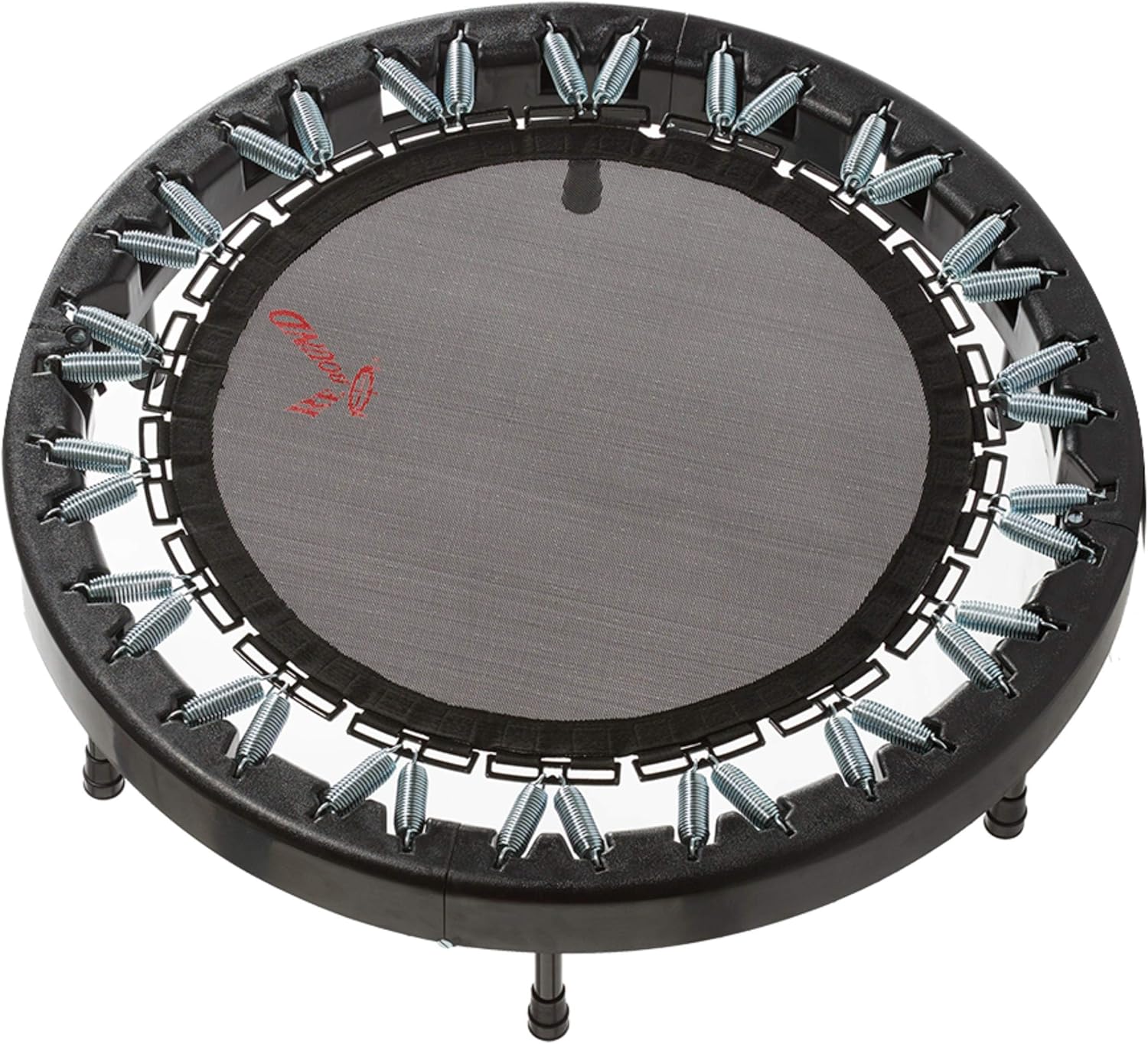
| Ultimate Rebounder by Rebound Air | 400 lbs | 48 inches | Heavy-Duty Steel Springs | Permatron Mat | Larger frame, folds in quarters | 28 lbs | Quarter-fold design, soft bounce for joint relief |
Want broader context on trampoline safety and what to watch for? Start here:
Are trampolines safe?
and
safest trampoline brands + safety rules.
Why “300 lb Capacity” Can Be Misleading (The Dynamic Load Reality)
Most rebounders are “rated” using a static test—meaning the manufacturer checks that the unit can hold a certain weight without movement. But rebounding is dynamic. When you bounce, your body generates G-forces that temporarily multiply the load going into the mat and suspension.
- Health bounce (gentle): roughly 1.5–2 G → a 300 lb user can create 450–600 lbs of load
- Aerobic bouncing (cardio): roughly 3–4 G → a 300 lb user can spike load to 900–1,200 lbs
What this means: many “300 lb” rebounders don’t fail because the steel ring snaps—they fail because the textile components (mat stitching, V-ring connections, fabric webbing) can’t survive thousands of repeated high-load cycles.
If you want a deeper overview of what “300 lb weight limit” really means in the rebounder world, this internal page is a great companion:
Mini trampoline 300 pound weight limit (what to look for).
What Fails First on High-Capacity Rebounders (The “Stitching Fuse”)
The most common catastrophic failure on budget rebounders is the V-ring tearing out of the mat. The V-rings (metal triangles) are sewn into the mat/webbing area, and under dynamic load, the thread stretches, frays, and eventually shears.
Think of the V-ring stitching as the rebounder’s fuse. The frame can be fine… and the rebounder still becomes unusable if one ring rips out.
Monthly safety check (takes 60 seconds)
- Look for fraying thread or loose stitches near V-rings
- Check for uneven mat tension (one area sagging more than others)
- Inspect springs/bungees for deformation or visible wear
If your rebounder mat needs a deeper clean (sweat + dust matters over time), here’s a practical internal guide:
How to clean a trampoline mat.
Springs vs Bungees for 300 lb+ Adults (What Actually Matters)
Steel springs (firm “stop” + less bottoming out)
Springs behave predictably: the deeper they stretch, the harder they resist. For heavier adults, this provides a firm “stop” that reduces the risk of bottoming out (hitting the floor). Springs can feel more stable for balance-focused workouts.
Tradeoff: springs generally transmit more shock into the joints than bungees—especially on cheaper models with basic springs.
Bungee cords (joint-friendly + quiet)
Bungees create a smoother deceleration curve and can absorb a large portion of impact shock, which is great for knees, hips, and lower back.
But: for heavier users, “one-size-fits-all” bungees are often too soft. If the mat sinks deeply into a cone shape, your feet may roll inward (pronation), stressing ankles and knees. This is why bungee systems must be properly tensioned for 300 lb+ use.
Related deep dives you may like:
best trampoline springs
and
best trampoline mats.
The Best Mini Trampolines for Adults (300 lb+ Capacity)
1) Bellicon (44″) — Best Overall for Joint Protection (Premium Pick)
If your priority is low-impact cardio with minimal joint stress, Bellicon is the gold standard—but only if you configure it correctly for your weight.
- Get the right bungees: for 300 lb+ adults, choose Extra Strong or Ultra Strong bungees (don’t guess here)
- Choose screw-in legs: for heavy users, screw-in legs reduce wobble and eliminate hinge “play”
- Maintenance reality: bungees are consumables—expect replacement roughly every 12–18 months with frequent use
Best for: knee/back sensitivity, daily use, quieter operation, long-term ownership.
Want more rebounder-focused context overall? This internal page supports broader rebounder intent:
Rebounder trampoline guide.
2) JumpSport 570 PRO — Best Safety & Stability (Most Confidence-Inspiring)
JumpSport’s PRO line is built around one key advantage: stability. The arched leg geometry creates a wider footprint that resists tipping if you land slightly off-center—something that matters a lot when you’re training at 300 lbs+.
- Adjustable tension: as cords stretch over time, you can re-tighten them (extends usable life)
- Great for beginners: feels “locked in” compared to many budget frames
- Note: the mat “petals” are safety coverage—your true jumping area is the inner mat
Best for: balance concerns, fear of tipping, confident cardio, long-term reliability.
3) Needak Hard Bounce — Best “Buy It For Life” Durability
Needak is the tank of rebounders. The Hard Bounce configuration is specifically tuned for heavier users (roughly 300–600 lbs) with stiffer springs that give you a responsive return without feeling like you’re sinking.
- High capacity with real-world margin: built for heavier bodies and long-term cycling
- Firmer ride: less “float,” more stability and cadence
- Tradeoff: springs can be louder than bungees and feel less forgiving than Bellicon
Best for: long-term ownership, firm bounce preference, stability-focused training.
4) Cellerciser (Bi-Fold) — Best Fast, “Gym-Like” Bounce
Cellerciser uses tapered spring behavior designed to feel responsive across a range of weights. Heavy users often describe it as fast and “athletic,” supporting higher cadence workouts.
- Responsive bounce: supports quick movement patterns
- Solid feel: sturdy hinge design compared to many foldables
- Tradeoff: still a spring system → a bit more “jar” than premium bungees
Best for: higher-intensity cadence, “trainer” style workouts, sturdy folding.
5) Acon Fit 55″ — Best Extra-Wide Platform (Space + Confidence)
If you feel cramped on a 40″ rebounder, the Acon Fit’s larger footprint is a big deal. More usable space increases confidence, reduces accidental edge landings, and supports wider-stance movements.
- Huge landing zone: better for big bodies and wide movements
- Quiet bungee suspension: great for apartments
- Caveat: it’s large and typically not a “store it under the bed” option
Best for: space, quiet workouts, wide stance movements, confidence.
Budget Options You Identified (What to Know Before You Buy)
These can work—especially if you’re starting out—but the key is setting expectations. For heavier adults, budget rebounders often become a cycle of parts replacement (springs, mats) or early retirement due to wear at the stitching and attachment points.
BCAN 48″ Foldable (claimed 440 lbs)
- Why it’s the best budget pick: larger diameter = more stability and more forgiving landings
- Common issue: spring breakage under heavy daily use (expect replacements over time)
- Watch-outs: folding hinge “play” can develop, and mat stitching is a known weak point
Who it’s for: you need something now, want the bigger surface, and you accept maintenance.
BCAN 40″ Foldable (claimed 330 lbs)
- Smaller platform: less forgiving for balance and edge landings
- Same spring/stitch concerns: just in a tighter footprint
Who it’s for: limited space, light “health bounce,” not aggressive cardio.
Anwick 40″ Foldable (claimed 330 lbs)
- Biggest complaint: noise (metal-on-metal squeak) and fast wear
- Rust risk: humid environments + sweat can accelerate oxidation
Who it’s for: ultra-tight budget, short-term use, you don’t mind maintenance.
Newan 40″ Silent (bungee, claimed 330 lbs)
- Why people like it: quieter bounce than springs
- Heavy-user risk: bungees can permanently stretch and mat can sag over time
- Connector risk: lower-grade clips/loops can fail under high tension
Who it’s for: quiet-only priority, lighter bouncing, not long-term heavy daily cardio.
Ultimate Rebounder by Rebound Air (claimed 400 lbs)
- Best feature: quarter-fold portability
- Heavy-user caveat: hinge flex can feel “wobbly” compared to more rigid frames
Who it’s for: portability is the main goal and you accept some compromise in rigidity.
If you want a broader roundup beyond this page’s “300 lb+” focus, you can also browse:
best mini trampoline reviews.
How to Choose (Simple Decision Guide)
- Joint pain / back sensitivity: Bellicon (Ultra Strong bungees, screw-in legs)
- Balance or tipping concerns: JumpSport 570 PRO
- Want something that lasts years (firm bounce): Needak Hard Bounce
- Need wide space + quiet: Acon Fit 55″
- Need budget now: BCAN 48″ (plan for spring + stitching maintenance)
Noise, Maintenance, and Safety Tips (Especially for Heavy Users)
How to reduce squeaks (springs)
Spring rebounders commonly squeak where metal meets metal. A thick lubricant lasts longer than thin sprays.
- Use white lithium grease (or petroleum jelly) on spring hooks
- Avoid thin sprays that evaporate quickly
- Expect to reapply periodically (dust/pet hair can stick to grease)
How to quiet bungee creaks
- Use a dry silicone lubricant on plastic-to-metal contact points
- Avoid oily lubricants that can degrade rubber over time
Monthly inspection checklist
- Check V-ring stitching for fray or loose thread
- Inspect springs for deformation or gaps
- Inspect bungees for stress marks, cracking, or permanent stretch
- Confirm legs are tight and the frame sits flat (no wobble)
For general upkeep, these internal pages are helpful:
trampoline care
and
how long trampolines last.
FAQ: Mini Trampolines for Adults Over 300 lbs
Is a “330 lb capacity” rebounder safe for a 300 lb adult?
Sometimes—but it depends on dynamic use and build quality. A 300 lb adult doing light “health bouncing” may be fine. A 300 lb adult doing aggressive cardio can spike forces far above the rating. On many budget models, the mat stitching and attachment points are the real failure risk.
What diameter is best for a 300 lb adult?
Bigger is usually safer. A 48″ rebounder often feels more stable and forgiving than a 40″ because it gives you more usable space and a wider stance. If you have the room, size is your friend.
Are bungees better than springs for heavy users?
Bungees are usually better for joints, but only if the tension is calibrated for your weight. Too-soft bungees can cause a deep “cone” shape that encourages ankle pronation and can even lead to bottoming out. Springs are firmer and reduce bottom-out risk, but can transmit more joint shock.
Do I need a handlebar?
For many 300 lb+ beginners, yes. A stability bar improves confidence, reduces fall risk, and lets you offload some weight through your arms while you build balance and endurance.
What’s the #1 thing I should inspect for safety?
The V-ring stitching (where the springs/bungees connect to the mat). Fraying, loose thread, or tearing near connection points is the earliest warning sign of a future failure.
How long should a high-quality rebounder last?
Premium frames can last many years (even decades). Consumables like bungees, mats, and springs will wear out depending on frequency and intensity. Regular inspection + replacing wear items before failure is the key to safe long-term use.