Uncategorized
Round vs rectangle trampoline
Choosing a trampoline shape isn’t just an aesthetic decision — it affects how the trampoline bounces, how safe it is for different age groups, how much space it needs, and how much you’ll pay. Round and rectangular are the two most popular shapes, and each one is built for a different type of user.
This guide walks through every important difference between round and rectangle trampolines so you can make the right call for your yard, your family, and how you actually plan to use it.
How Shape Affects the Bounce
The shape of a trampoline determines how the springs behave — and that’s what creates the bounce you feel.
On a round trampoline, all the springs work together simultaneously. When you jump, the tension distributes evenly across the entire mat, which naturally pulls you toward the center. This creates a softer, more controlled bounce that’s forgiving for beginners and younger children. The tradeoff is that bounce height is highest in the center and drops off as you move toward the edges, giving you a smaller “sweet spot” for peak performance.
On a rectangular trampoline, the springs work independently. Only the springs nearest to your landing point engage, which means you get a consistent, powerful bounce no matter where you land on the mat. This independent spring action produces higher jumps, better control, and a more responsive feel — which is why rectangular trampolines are the standard in gymnastics training and competitive use.
If you want the deepest dive into how spring systems affect performance, our guide to trampoline springs covers materials, tension, and longevity in detail.
Round vs Rectangle Trampoline: Quick Comparison
| Feature | Round Trampoline | Rectangle Trampoline |
|---|---|---|
| Bounce type | Softer, center-directed | Higher, even across entire mat |
| Spring action | All springs engage together | Springs work independently |
| Best jump zone | Center of the mat | Entire mat surface |
| Best for | Families, kids, casual bouncing | Gymnastics, tricks, athletes, teens |
| Safety (single jumper) | Higher — center-pull reduces edge falls | Moderate — no center-pull, higher jumps |
| Safety (multiple jumpers) | Lower — center-pull increases collision risk | Higher — more spread-out jumping area |
| Weight capacity | 200–450 lbs (size dependent) | 300–550+ lbs |
| Typical sizes | 8 ft, 10 ft, 12 ft, 14 ft, 15 ft | 10×17 ft, 14×16 ft, 7×14 ft |
| Yard space needed | Equal clearance on all sides (circular footprint) | Fits narrow or rectangular yards better |
| Price range | $150–$2,000 | $400–$4,000+ |
| Assembly | Generally easier | More complex, heavier frames |
Safety: Which Shape Is Safer?
The answer depends on how the trampoline is being used.
For a single young jumper, round trampolines are generally safer. The center-directed bounce naturally guides children away from the edges, reducing the risk of contact with the frame or springs. This is why round trampolines dominate the residential market — the shape itself acts as a passive safety feature. Combined with a quality enclosure net and proper spring padding, a round trampoline offers a well-protected bouncing environment for kids.
For multiple jumpers (though we always recommend one jumper at a time), rectangular trampolines actually have a safety advantage. The larger, more evenly distributed bounce area gives jumpers more room to spread out, reducing the collision risk that round trampolines create by funneling everyone to the center.
For experienced jumpers and athletes, rectangular trampolines provide the controlled, predictable bounce needed for practicing flips and tricks safely. The consistent rebound across the mat lets you land with precision, which actually reduces injury risk during skill development — as long as you have the skill level to match the equipment.
Regardless of shape, safety features like enclosure nets, padded frames, and adherence to trampoline safety rules matter far more than shape alone.
Weight Capacity and Durability
Rectangular trampolines typically handle more weight than round models of comparable size. This comes down to spring mechanics: because rectangular trampolines only engage the springs closest to the jump point, each spring bears less stress per jump. The frame also distributes forces differently, with reinforced corners handling peak loads more efficiently.
Most round trampolines support 200–450 lbs depending on size — an 8-foot model might cap at 200 lbs, while a 15-foot model can handle 350–450 lbs. Rectangular trampolines generally start at 300 lbs and go up to 550 lbs or more for professional-grade models. Heavy-duty options from brands like ACON, Avyna, and Galactic Xtreme push structural load capacities well past 1,000 lbs.
For detailed weight information by brand, see our guides on Skywalker weight limits and Springfree weight limits.
Space Requirements and Yard Fit
This is where shape becomes a very practical consideration. A round trampoline needs equal clearance on all sides — a 14-foot round model needs roughly an 18-foot diameter circle of open ground. That works well in spacious, square-ish yards but can be wasteful in narrow or rectangular spaces.
A rectangular trampoline can tuck more efficiently into longer, narrower yards and even sit closer to a fence line along its short side. If your backyard is more of a corridor than a courtyard, a rectangle may give you a larger usable jumping surface within the same total footprint.
Both shapes need at least 24 feet of overhead clearance (watch for tree branches and power lines) and a flat, level surface. For families considering sinking a trampoline into the ground to save visual space and reduce fall height, our in-ground trampoline installation guide covers everything you need to know.
Cost Differences
Round trampolines are significantly more affordable. They use simpler frame designs, require fewer springs, and are manufactured in much higher volumes — all of which keeps the price down. A quality 12–14 foot round trampoline from a reputable brand like Skywalker, Jumpzylla, or JumpFlex typically costs $200–$600.
Rectangular trampolines cost more due to their more complex frame engineering. The corners require reinforcement, the independent spring system demands precise tensioning, and shipping costs are higher due to heavier, longer boxes. Expect to spend $400–$1,500 for a solid family rectangle, and $1,500–$4,000+ for professional or heavy-duty models from brands like ACON, Happy Trampolines, or Springfree.
Beyond the purchase price, ongoing maintenance costs are similar for both shapes. Springs, mats, nets, and pads all wear out at roughly the same rate. Our trampoline parts checklist helps you stay on top of replacements.
Best Uses for Each Shape
Round trampolines work best for: Families with younger children (under 12) who want safe recreational bouncing. Casual backyard fun where high-performance bounce isn’t a priority. Tighter budgets. Yards with a square or open layout. First-time trampoline buyers who want a straightforward, proven setup.
Rectangle trampolines work best for: Gymnasts, cheerleaders, and athletes who need consistent bounce for skill development. Teens and adults who want higher jumps and more airtime. Families that want a trampoline that grows with their kids as their skills progress. Narrow or rectangular backyards where a round model would waste space. Households where multiple family members (including adults) will use the trampoline regularly.
Not sure which specific models to look at? Our rectangle trampoline reviews and best trampolines for kids guide cover top-rated options in each category.
What About Oval Trampolines?
Oval trampolines split the difference between round and rectangular. They offer a longer jumping surface than a round trampoline with some of the center-pull safety characteristics. The springs near the ends operate somewhat independently (like a rectangle), while the springs along the sides work more collectively (like a round). Brands like ACON, Berg, and Springfree all offer oval options.
If you want the athletic benefits of a rectangle but the safety profile of a round, an oval is worth considering — especially for families with kids who are progressing beyond basic bouncing into tricks and skills.
Frequently Asked Questions
Do rectangle trampolines bounce higher than round?
Yes. The independent spring action on rectangular trampolines produces a higher, more powerful bounce. On a round trampoline, all springs engage at once, which limits maximum height but creates a softer feel.
Are round trampolines safer than rectangle?
For single young jumpers, yes — the center-pull design naturally keeps kids away from the edges. For experienced jumpers practicing skills, rectangular trampolines can be safer because the consistent bounce allows for more controlled landings.
Why are rectangle trampolines more expensive?
They require more complex frame engineering, reinforced corners, and more precise spring tensioning. The heavier frames also increase shipping costs. The manufacturing process takes longer and demands more material than round models.
Can you do gymnastics on a round trampoline?
You can practice basic skills, but serious gymnastics training is better suited to a rectangular trampoline. The consistent bounce surface and higher lift on a rectangle give you the control needed for flips, twists, and progressive skill development.
What size round trampoline is best for a family?
A 12 to 14-foot round trampoline is the most popular family size. It offers enough jumping space for kids and teens while fitting comfortably in most suburban backyards. Check our ultimate buying guide for size recommendations by age and yard size.
How much weight can each shape hold?
Round trampolines typically support 200–450 lbs depending on size. Rectangular trampolines generally handle 300–550+ lbs. Always check the specific model’s weight capacity — our weight limit guides cover this by brand.
Rebounder vs mini trampoline
“Rebounder” and “mini trampoline” get tossed around like they mean the same thing — and in casual conversation, most people treat them as synonyms. But if you’re shopping for one, the distinction actually matters. The design, bounce feel, intended use, and price can vary significantly depending on which category a product falls into.
This guide explains the real differences between rebounders and mini trampolines so you can buy the right one for your needs — whether that’s fitness, fun for the kids, or a bit of both.
Defining the Terms
A rebounder is a small trampoline engineered specifically for fitness. It typically measures 36 to 44 inches in diameter, uses bungee cords (or occasionally short, high-tension springs) for a deep and controlled bounce, and is built for a single adult user. The bounce on a rebounder pushes down rather than launching you up — that’s by design. The resistance is what makes the workout effective. Many rebounders include an adjustable handlebar and foldable legs for portability and storage.
A mini trampoline is a broader category. It includes any small trampoline — typically 36 to 55 inches — designed for indoor or limited-space use. Some mini trampolines are built for exercise (and are functionally rebounders), but others are built for children’s recreation, with enclosure nets, padded edges, and a bouncier feel more similar to a scaled-down backyard trampoline. The term also covers competition “mini tramps” used in gymnastics, which are entirely different in purpose and construction.
For a complete breakdown of what’s available in the mini trampoline category, see our mini trampoline buyer’s guide.
Side-by-Side Comparison
| Feature | Rebounder | Mini Trampoline (Recreational) |
|---|---|---|
| Designed for | Adult fitness and exercise | Kids’ play, general bouncing, or light exercise |
| Typical diameter | 36–44 inches | 36–55 inches |
| Bounce system | Bungee cords (most common) or high-tension springs | Metal springs (most common) or bungee cords |
| Bounce feel | Deep, firm, resistant — you push into the mat | Springy, higher — closer to a backyard trampoline feel |
| Handlebar | Usually included or available | Sometimes included; often replaced by enclosure net on kids’ models |
| Safety features | Non-slip feet, stability bar, low profile | Enclosure net, padded edges, handrails (kids’ models) |
| Foldable | Often yes | Sometimes |
| Weight capacity | 250–450 lbs | 100–300 lbs (varies widely) |
| Noise level | Quiet (especially bungee models) | Can be noisy (spring-based models) |
| Price range | $100–$800+ | $50–$300 |
| Best for | Adults seeking structured cardio, balance, or rehab workouts | Kids’ indoor play, light bouncing, casual exercise |
The Bounce Is the Biggest Difference
If you’ve ever bounced on a kids’ mini trampoline and then tried a quality rebounder, the difference is immediately obvious. A mini trampoline with metal springs gives you a springy, upward bounce — it feels fun and playful, almost like a smaller version of a backyard trampoline. The surface has more give, and you naturally bounce higher.
A rebounder, particularly one with bungee cords, absorbs your weight differently. The bounce is shorter and more controlled. You feel resistance pushing back against your feet, which forces your muscles — especially your core, glutes, and calves — to engage on every single bounce. That’s why rebounders are used for exercise: the resistance is the workout.
This also affects joint impact. Bungee rebounders are significantly gentler on knees, hips, and ankles compared to spring-based mini trampolines. If joint health is a concern, or if you’re using the equipment for rehabilitation, a bungee rebounder is the better choice.
Who Uses What?
Rebounders are primarily used by adults for home fitness. They’re popular among people who want an effective cardio workout without the impact of running, as well as physical therapy patients working on balance and coordination. Fitness classes built around rebounding have grown substantially in recent years, and the equipment is a staple in many home gyms.
Mini trampolines have a broader user base. Recreational models designed for children are among the most popular — they’re a great way for kids to burn energy indoors, especially during winter months. If you’re shopping for a younger child, our mini trampolines for kids guide covers the safest options by age group. Some adults also use mini trampolines for casual bouncing or light exercise, though they won’t deliver the same workout intensity as a purpose-built rebounder.
For adults specifically looking for a high-capacity model, our guide to mini trampolines with 300 lb capacity reviews the sturdiest options on the market.
Build Quality and Durability
Rebounders, particularly those in the $200+ range, tend to be built with higher-quality materials. The frames are often made from heavy-gauge steel, the mats use tighter weaves, and the bungee cords are engineered for tens of thousands of bounces before needing replacement. Brands like JumpSport, Bellicon, and Cellerciser focus exclusively on rebounders and invest heavily in engineering their bounce systems.
Mini trampolines aimed at children prioritize affordability and safety features like enclosure nets and padded edges over raw build quality. That doesn’t mean they’re poorly made — brands like Skywalker, Jumpzylla, and ACON produce solid kids’ models — but they’re designed for lighter, less frequent use than an adult fitness rebounder.
Noise: A Practical Consideration
If you’re bouncing indoors — in an apartment, above a garage, or in any shared-wall situation — noise matters. Bungee rebounders are nearly silent. Spring-based mini trampolines can produce a rhythmic squeaking or metallic pinging that becomes noticeable quickly, especially on hard floors. If quiet operation is important to you, a bungee-cord rebounder is the clear winner.
Which Should You Choose?
Buy a rebounder if: You’re an adult who wants a serious, low-impact workout tool. You want quiet indoor exercise. You value controlled bounce and joint protection. You plan to use it regularly as part of a fitness routine.
Buy a mini trampoline if: You’re shopping for a child who needs an indoor play outlet. You want casual, fun bouncing without a structured workout goal. You’re on a tighter budget and want something affordable. You want the option of an enclosure net for younger jumpers.
And if what you’re really after is a full-size outdoor trampoline for the family, that’s a different comparison entirely. Our ultimate trampoline buying guide will point you in the right direction.
Frequently Asked Questions
Are rebounders and mini trampolines the same thing?
Not quite. “Mini trampoline” is a broad term for any small trampoline, while “rebounder” refers specifically to small trampolines designed for fitness. All rebounders are mini trampolines, but not all mini trampolines are rebounders.
Can kids use a rebounder?
Older children can use rebounders under adult supervision, but most rebounders don’t include the safety enclosures that kids’ mini trampolines have. For younger children, a dedicated kids’ model with a net is safer.
Is bungee better than springs for a mini trampoline?
For fitness, yes — bungee cords provide a quieter, smoother, more joint-friendly bounce. For kids who want a springy, playful feel, metal springs are fine as long as they’re covered by safety padding.
How much space does a rebounder need?
Plan for about 4 feet of floor space in diameter, plus enough overhead clearance for comfortable bouncing (standard 8-foot ceilings work for most people). Many rebounders fold flat for storage between workouts.
What’s a good rebounder for beginners?
Look for a bungee-cord model with an adjustable handlebar and a weight capacity that exceeds your body weight by at least 50 lbs. Our rebounder trampoline guide reviews top options for all experience levels.
Rebounder vs trampoline
If you’re trying to decide between a rebounder and a trampoline, you’re not alone. These two pieces of equipment look similar on the surface — they both involve bouncing, after all — but they’re designed for very different purposes. One is a compact fitness tool built for indoor workouts. The other is a full-size backyard staple built for recreation, play, and family fun.
This guide breaks down every meaningful difference between rebounders and trampolines so you can choose the right one for your goals, your space, and your budget.
What Is a Rebounder?
A rebounder is a small, portable trampoline designed specifically for exercise. Most rebounders measure between 36 and 48 inches in diameter and sit low to the ground. They use either bungee cords or short metal springs to create a firm, controlled bounce that’s ideal for low-impact cardio, balance training, and strength work.
Unlike a backyard trampoline, the goal on a rebounder isn’t to jump high — it’s to jump into the mat. That deeper, more resistant bounce engages your core, legs, and stabilizing muscles more intensely than a traditional trampoline bounce. Many models come with an adjustable handlebar for extra stability, which is especially helpful for beginners, seniors, or anyone recovering from injury.
If you want a deeper look at rebounder features and our top picks, check out our complete guide to rebounder trampolines.
What Is a Trampoline?
A trampoline — in the traditional sense — is a large outdoor structure with a steel frame, a woven polypropylene mat, and a set of springs (or, in the case of brands like Springfree, composite rods) that produce a high, dynamic bounce. Backyard trampolines typically range from 8 to 16 feet in diameter and are designed for recreational jumping, tricks, gymnastics practice, and general family fun.
Most full-size trampolines include a safety enclosure net and padded spring covers. They’re available in rectangular and round shapes, each with different bounce characteristics. Trampolines are a significant investment in both money and yard space, but they provide years of entertainment and exercise for kids and adults alike.
For a full rundown of what to look for when buying one, see our 2026 backyard trampoline buyer’s guide.
Rebounder vs Trampoline: Key Differences at a Glance
| Feature | Rebounder | Trampoline |
|---|---|---|
| Size | 36–48 inches diameter | 8–16 feet diameter |
| Primary use | Fitness and exercise | Recreation, play, and athletics |
| Location | Indoors (living room, gym, apartment) | Outdoors (backyard) |
| Bounce type | Low, controlled, resistant | High, dynamic, springy |
| Bounce system | Bungee cords or short springs | Metal springs or composite rods |
| Weight capacity | 250–450 lbs (varies by model) | 200–1,650 lbs (varies by model and size) |
| Users | One person (solo workouts) | One or more (family use) |
| Portability | Lightweight, often foldable | Stationary once assembled |
| Safety features | Handlebar, non-slip feet | Enclosure net, padded springs, ladder |
| Price range | $70–$800+ | $150–$4,000+ |
| Maintenance | Minimal (wipe down, tighten bolts) | Regular (replace springs, mat, net over time) |
Bounce Quality and Performance
This is where the two diverge most dramatically. A rebounder delivers a deep, firm bounce with more resistance. The mat absorbs your weight and pushes back, which is what makes rebounding such an effective workout — your muscles have to work harder on every bounce. Bungee-cord rebounders tend to be quieter and gentler on joints, while spring-based rebounders offer a slightly firmer, more responsive feel.
A full-size trampoline, by contrast, is engineered for height and airtime. The springs store and release energy to launch you upward, which is why trampolines are the tool of choice for gymnastics training, tricks, and aerial awareness. If you’re interested in the mechanics behind how trampoline springs affect performance, we’ve covered that in detail.
Neither bounce type is “better” in absolute terms — it depends entirely on what you’re trying to accomplish.
Fitness and Health Benefits
Both rebounders and trampolines offer genuine health benefits, but they target fitness in different ways.
Rebounders excel at structured, repeatable workouts. The controlled bounce is ideal for cardiovascular conditioning, lymphatic stimulation, core strengthening, and balance improvement. Because the impact is low, rebounding is particularly well-suited for people with joint issues, older adults, or anyone who finds running or traditional cardio too jarring. You can incorporate HIIT intervals, resistance bands, or light hand weights to increase intensity.
Trampolines offer a more dynamic form of exercise. Jumping on a full-size trampoline builds coordination, spatial awareness, and explosive power. It’s also a fantastic way to get kids (and adults) moving without it feeling like exercise. For more structured trampoline fitness routines, see our guide to trampoline exercises.
Safety Considerations
Rebounders are generally considered safer because they sit low to the ground and the bounce is controlled. The biggest risks are stepping off the edge or losing balance, which a handlebar largely prevents. There’s no risk of falling from height.
Trampolines carry more inherent risk — especially for children — because the bounce is higher and more powerful. That said, modern trampolines have come a long way. Safety enclosures, padded springs, no-gap designs, and springless options (like those from Springfree) have significantly reduced injury rates. Following basic rules like one jumper at a time and no unsupervised flips makes a major difference.
For a thorough look at trampoline injury prevention, read our guide on trampoline safety for kids.
Space Requirements and Setup
A rebounder needs roughly 4 feet of floor space and enough overhead clearance for comfortable bouncing — a standard ceiling height works fine. Most rebounders can be set up in minutes, folded for storage, and moved from room to room easily. This makes them a practical choice for apartments, home gyms, or anyone with limited outdoor space.
A backyard trampoline is a different commitment entirely. Even a mid-size 12-foot round model needs approximately 16 feet of clear ground space (accounting for safety clearance on all sides) and at least 24 feet of overhead clearance. Assembly typically takes 2–4 hours, and the trampoline stays put once it’s installed. If you’re considering an in-ground setup to save visual space, our in-ground trampoline installation guide covers the full process.
Cost and Long-Term Value
Rebounders are generally the more affordable option up front. You can find decent models starting around $70–$100, with high-end rebounders from brands like JumpSport, Bellicon, and Cellerciser running $200–$800 or more. Maintenance costs are minimal — the bungee cords or springs last for years under normal use.
Backyard trampolines range from under $200 for budget models to over $4,000 for premium options from brands like Springfree, ACON, or Vuly. On top of the purchase price, you’ll need to factor in replacement parts over time — springs, mats, nets, and pads all wear out, especially with heavy use and weather exposure. Our trampoline parts checklist can help you budget for ongoing maintenance.
Which One Should You Buy?
Choose a rebounder if you:
Want a dedicated fitness tool for indoor, solo workouts. Prefer low-impact exercise that’s easy on your joints. Live in an apartment or home with limited outdoor space. Want something portable that stores easily. Are focused on cardio, lymphatic health, or rehabilitation.
Choose a trampoline if you:
Have kids and want an outdoor activity that gets them moving. Have backyard space and want a long-term recreational investment. Want versatility — exercise, play, tricks, and family fun. Are interested in gymnastics training or aerial skills. Want something the whole family can enjoy for years.
And if you’re specifically looking for a small trampoline for children, our mini trampolines for kids guide covers the best options designed for younger jumpers.
Frequently Asked Questions
Is a rebounder the same thing as a mini trampoline?
Not exactly. While the terms are often used interchangeably, rebounders are specifically designed for fitness and feature a firmer, more controlled bounce. Mini trampolines can refer to any small trampoline, including recreational models for kids. For a detailed breakdown, see our comparison of mini trampolines vs rebounders.
Can I use a trampoline for exercise instead of a rebounder?
Absolutely. Full-size trampolines can provide excellent cardio and full-body workouts. However, rebounders are purpose-built for exercise, so you’ll get a more controlled and structured workout experience on one.
Are rebounders safe for seniors?
Yes, rebounders with handlebars are widely used by older adults for low-impact exercise and balance training. The low height and controlled bounce minimize fall risk. Always start slowly and use the stability bar until you feel confident.
How long do rebounders last?
A quality rebounder typically lasts 5–10 years or more with normal use. Bungee cords may need replacement after several years of heavy use, but this is an inexpensive repair.
Can adults use backyard trampolines?
Yes — just make sure the trampoline is rated for adult weight. Our heavy-duty trampolines for adults guide covers models with weight capacities of 300 lbs and above.
Which burns more calories — a rebounder or a trampoline?
Both can deliver effective calorie-burning workouts, but the results depend more on intensity and duration than the equipment itself. A focused 30-minute rebounder HIIT session can burn as many calories as a longer, more casual session on a full-size trampoline.
Top 7 Best Rectangle Trampolines – The Complete Guide for Families, Athletes & Backyard Fun
Thinking about buying a rectangle trampoline? You’re not alone. Rectangle trampolines are increasingly popular with families, athletes, and anyone who wants the ultimate backyard bounce experience. Unlike traditional round trampolines, rectangles offer a higher, more consistent bounce, making them a top pick for gymnasts and serious jumpers—but they’re just as fun (and safe) for everyday family use.
This guide covers everything you need to know about the best rectangle trampolines in 2026, including what to look for, detailed product breakdowns, a comparison table, answers to common buyer questions, and a checklist to help you pick the perfect model. If you’re still deciding between shapes, sizes, and brands, our Ultimate Trampoline Buying Guide is a great place to start.
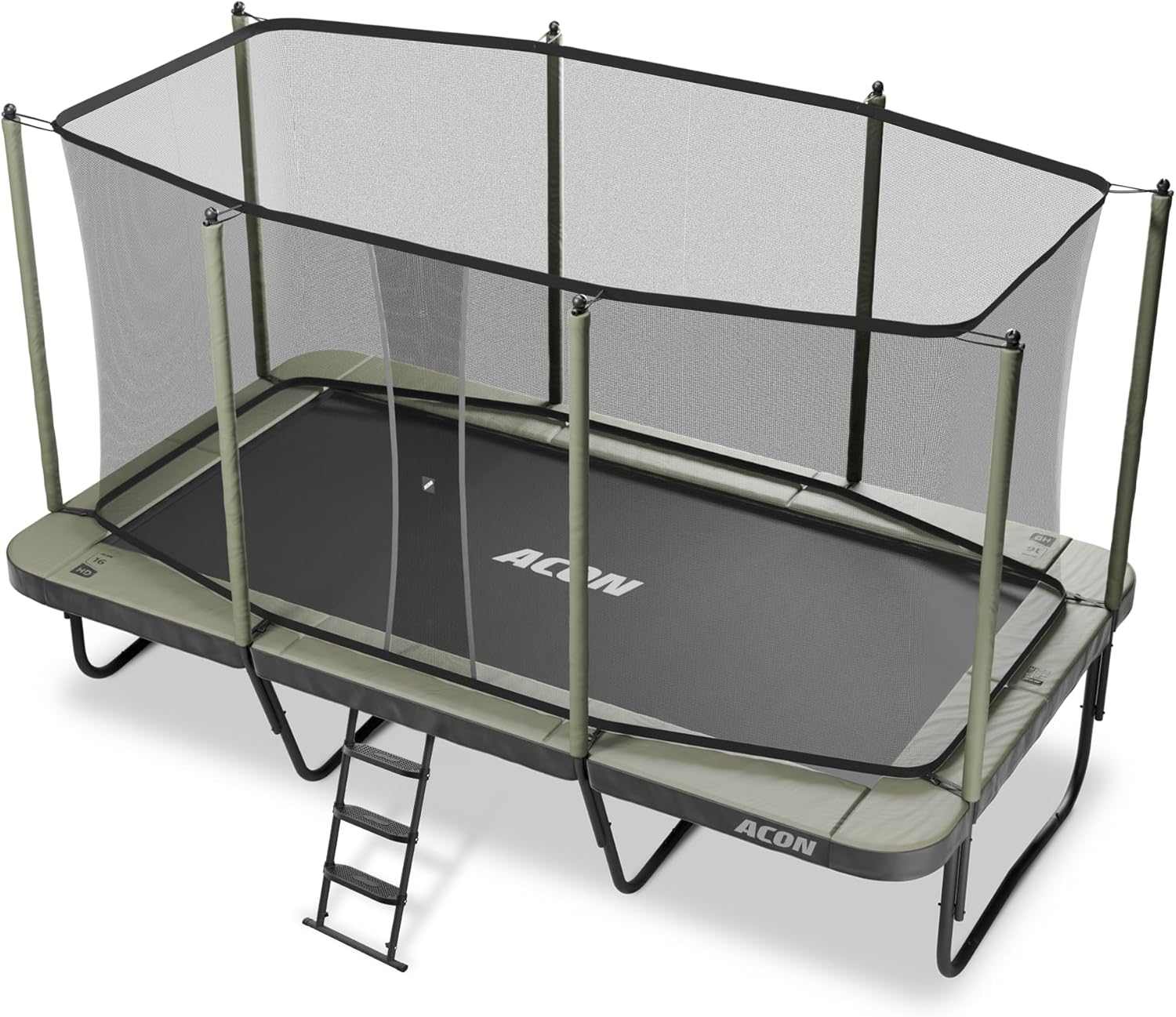
Click Here For Our Favorite Trampoline
Why Choose a Rectangle Trampoline Over a Round One?
Rectangle trampolines aren’t just for gymnasts or cheerleaders—though they are the gold standard for anyone serious about flips and tricks. Here’s what makes rectangular trampolines different from round models:
- Even Bounce Across the Entire Surface: On a round trampoline, the springs pull you toward the center. On a rectangle, the springs work independently—so the bounce is consistent no matter where you jump on the mat. This is why competitive gymnasts train on rectangular shapes.
- Bigger Usable Jumping Surface: Rectangle trampolines have more edge-to-edge usable space than round models of similar dimensions. That means more room for tricks, and more space if multiple family members want to be on the mat (though we always recommend one jumper at a time for safety—more on that in our trampoline safety guide).
- Pro-Level Performance: Preferred for gymnastics, cheer, and athletic training. The responsive, softer bounce gives you more control in the air.
- Fits Yard Corners & Narrow Spaces: The rectangular shape often fits along fence lines or in yard corners where a round trampoline simply wouldn’t work.
If you want the best possible bounce, plan to have more than one person jumping, or just want a trampoline that feels “pro” in every way, a rectangle model is worth the upgrade. Not sure about the cost difference? See our trampoline pricing guide for a detailed breakdown by shape and brand.
How to Choose the Best Rectangle Trampoline: What to Look For
Choosing the right rectangle trampoline means balancing safety, bounce quality, durability, and your available space. Here’s what matters most:
Safety Features
- Full enclosure net with sturdy zippers or latches—look for “no-gap” systems like those found on Skywalker models (learn more about how to choose the best trampoline net)
- Padded poles and fully covered springs (spring padding prevents pinched fingers and impact injuries)
- Gap-free jumping surfaces
- Safety certifications (ASTM, TUV)—these indicate the trampoline has been tested to rigorous standards
Size & Space Requirements
- Common rectangle sizes: 8×13, 9×15, 10×17, and 10×16 feet
- Measure your yard carefully—allow at least 3 feet of clearance on all sides and 24 feet of overhead clearance to avoid trees and power lines
- If space is tight, the 8×13 ft (like the Acon Air 13) is a great option that still provides pro-level bounce
Bounce Quality & Weight Limit
- High-performance springs deliver better, more responsive bounce. Upgrading your springs later can also improve performance.
- Check max weight capacity—this ranges from 200 lbs on budget models to 1,100+ lbs on premium units like the Acon Air 16
- If adults and kids will be jumping, look for models rated 500 lbs or higher
- For a deeper dive into how weight limits work and why they matter, see our weight limit guide
Frame & Durability
- Look for galvanized, rust-resistant steel frames with thick-gauge tubing (11–14 gauge is ideal)
- UV-resistant jumping mats and nets extend the trampoline’s lifespan
- Hot-dip galvanized frames (used by brands like Acon and Zupapa) resist rust far better than standard coatings
Assembly
- Most rectangle trampolines require 2+ adults and 2–6 hours for setup
- Check if the manufacturer provides video instructions—these make a huge difference
- Rectangular frames are more complex than round ones, so plan accordingly
Accessories
- Ladder, basketball hoop, anchor kit, and storage bag are common add-ons
- A weather cover is highly recommended for off-season protection
- Some families also love adding a trampoline tent for camping-style backyard fun
Warranty & Support
- Longer frame, mat, and spring warranties indicate manufacturer confidence—10 years on the frame is the gold standard
- Responsive customer service for replacement parts is important, especially for premium trampolines you’ll own for many years
- Compare warranty terms across brands in our best trampoline brands guide
Top 7 Best Rectangle Trampolines (2026 Reviews)
We’ve tested, researched, and compared the top rectangular trampolines available in 2026. Here’s our detailed breakdown of each model, ranked by overall quality and value.
1. Acon Air 16 Sport HD Rectangular Trampoline — Best Overall
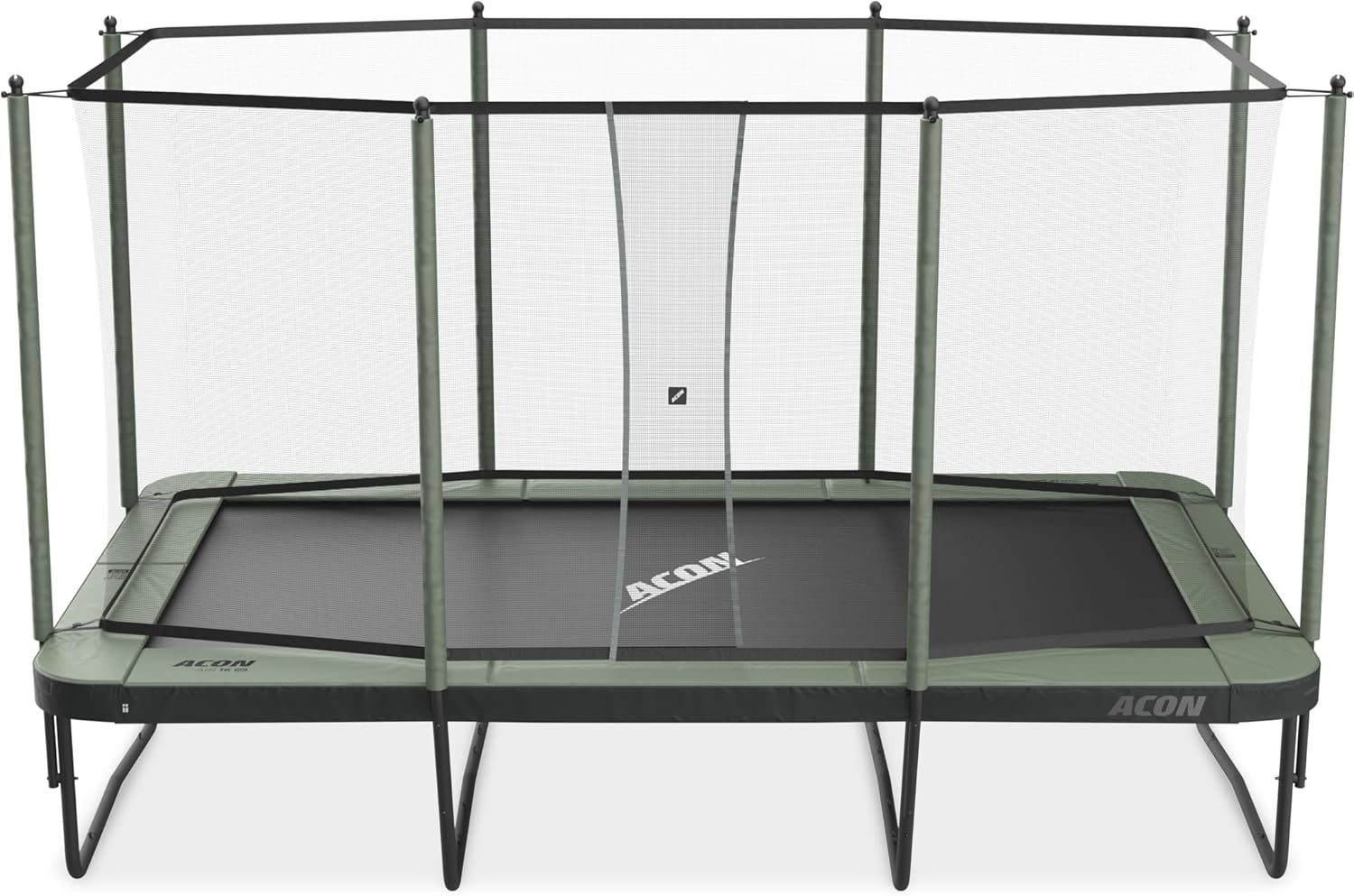
Size: 10 x 16 ft | Weight Limit: 1,100 lbs | Price Range: $$$$
The Acon Air 16 Sport HD is the flagship rectangular trampoline for families, gymnasts, and serious jumpers. Acon is a Finnish manufacturer known for building trampolines that last a decade or more, and the 16 HD is their crown jewel. It features a massive 10×16-foot jumping surface, a reinforced heavy-duty frame, and a premium enclosure system. The 1,100 lb weight limit means multiple family members can use it throughout the day without concern. A ladder is included, and you can upgrade to Acon Piano Wire Springs for even more bounce.
- Best For: Pro-level performance, big families, gymnasts, and athletic teens
- Pros: Legendary bounce quality, extremely durable frame, safe for all ages, 10+ year warranty
- Cons: High price point, large footprint requires a big yard
- Why Buy: If you want the best of the best and plan to use your trampoline for years of serious bouncing
2. Acon Air 13 Sport HD Rectangular Trampoline — Best for Smaller Yards
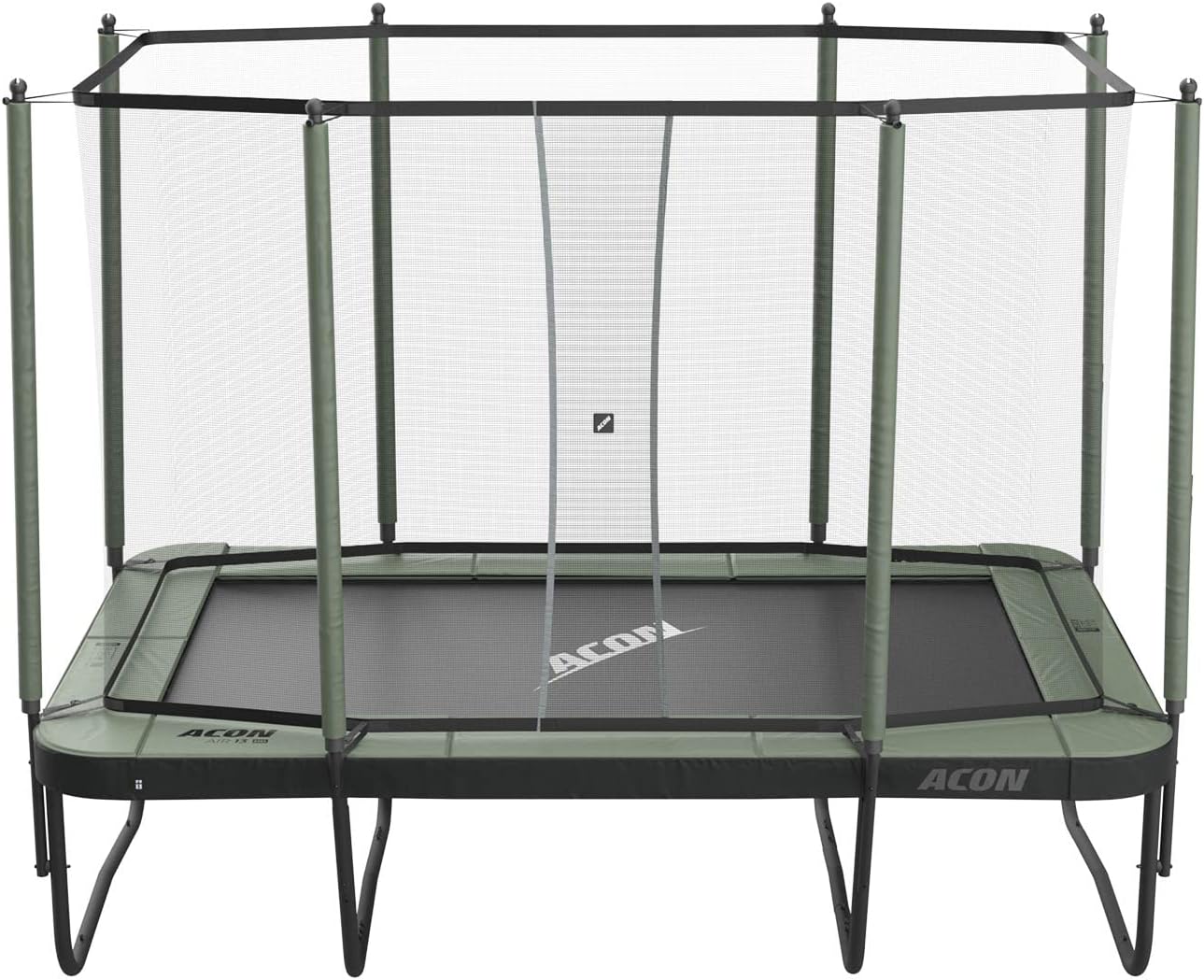
Size: 8 x 13 ft | Weight Limit: 800 lbs | Price Range: $$$
The Acon Air 13 Sport HD is the smaller sibling of the 16 HD, built with the same premium materials and engineering but sized for yards that can’t fit a 10×16 model. At 8×13 feet, it still provides a generous jumping area and the same pro-level bounce quality that Acon is known for. The 800 lb weight capacity is more than enough for families with kids and teens.
- Best For: Quality-focused buyers with limited yard space
- Pros: Same excellent build quality as the Acon 16, fits in smaller yards, premium net and frame
- Cons: Still pricier than budget brands, assembly takes time
- Why Buy: You want Acon’s top-tier performance but have limited outdoor space
3. Upper Bounce Mega 10′ x 17′ Gymnastics Rectangle Trampoline — Best for Gymnasts
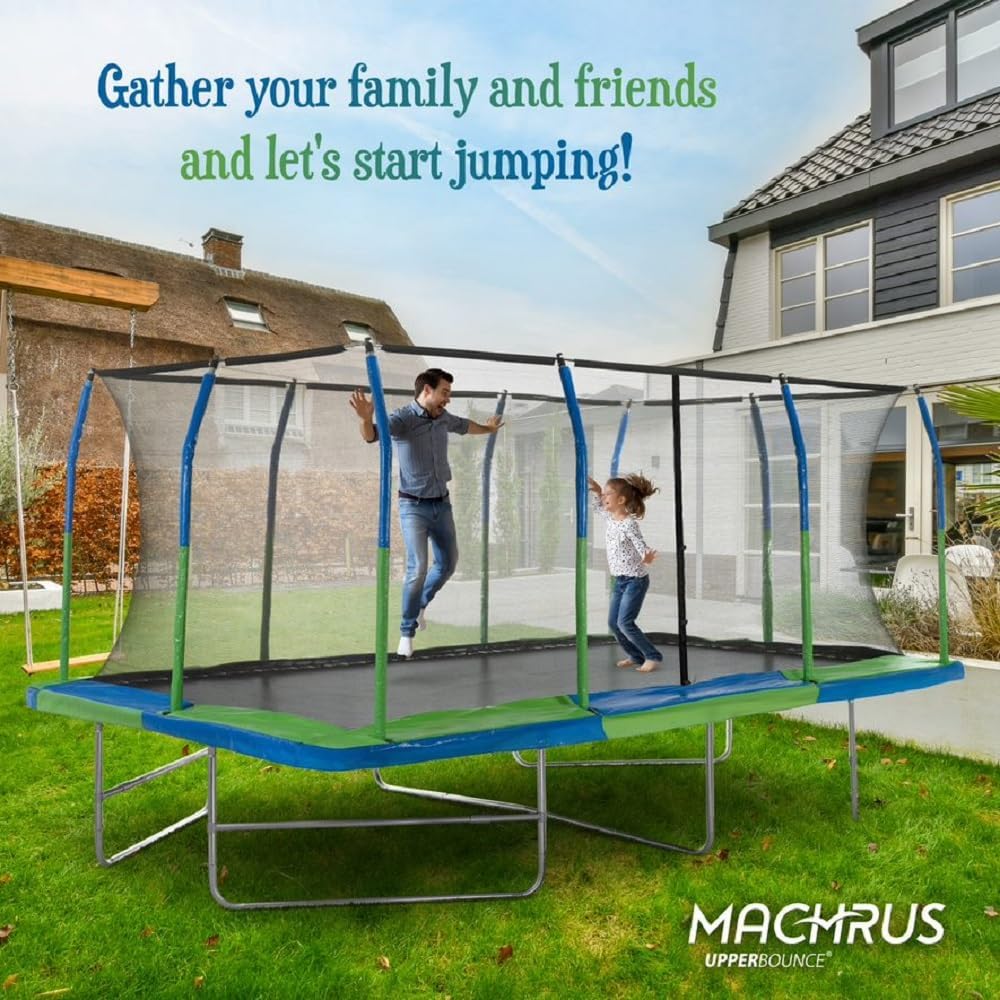
Size: 10 x 17 ft | Weight Limit: 500 lbs | Price Range: $$$
The Upper Bounce Mega is one of the largest consumer-grade rectangle trampolines you can buy. The 10×17-foot surface gives gymnasts, cheerleaders, and aspiring athletes room to practice tumbling, flips, and aerial routines at home. The high-bounce spring system delivers serious airtime, and the robust enclosure keeps jumpers safely contained.
- Best For: Gymnasts, aspiring athletes, families with multiple active kids
- Pros: Spacious mat, strong responsive bounce, solid safety features
- Cons: Setup instructions can be confusing, 1-year warranty is short for this price range
- Why Buy: Great for advanced jumpers who need maximum space to practice skills
4. JumpKing 10’x15′ Rectangle Trampoline with Basketball Hoop — Best Value with Extras
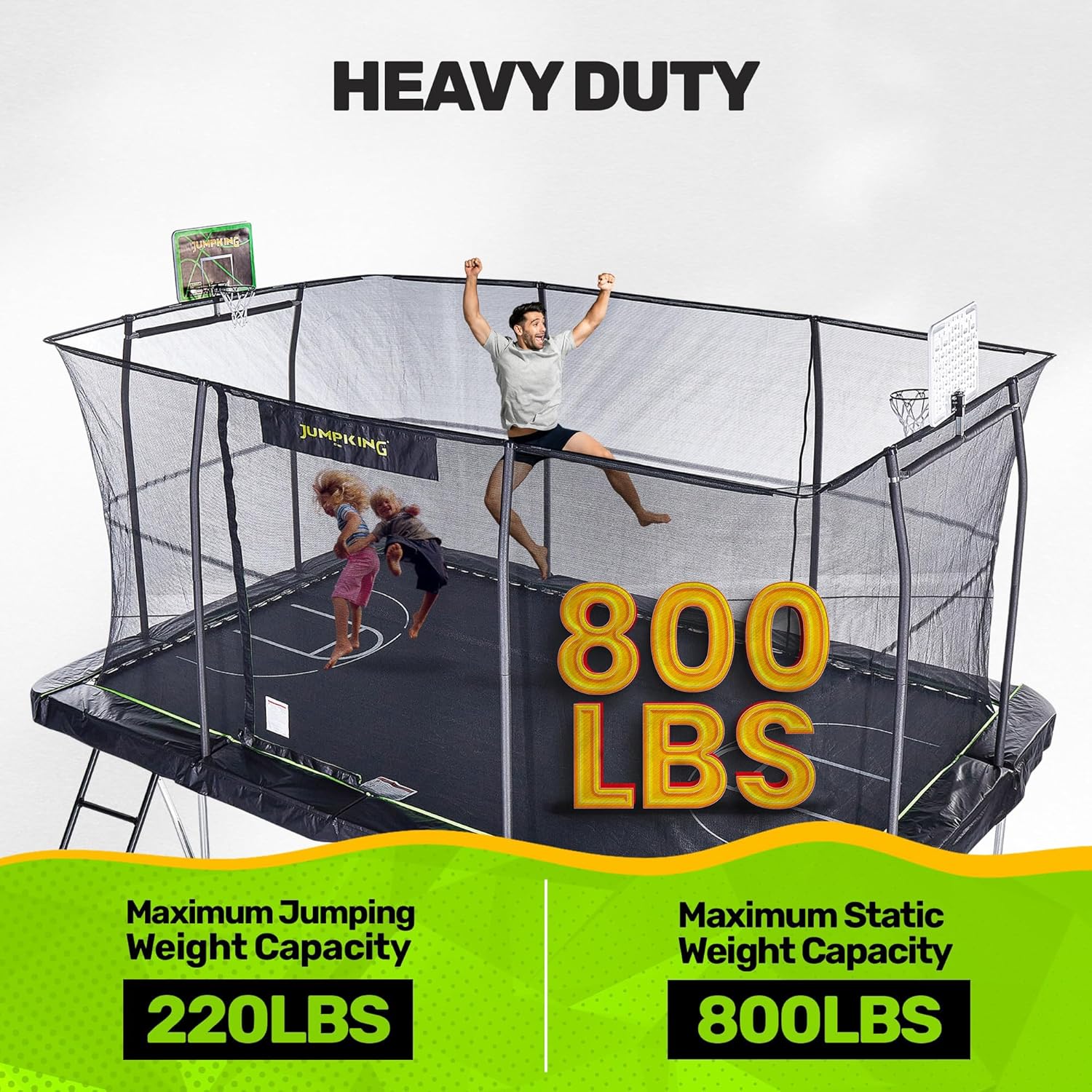
Size: 10 x 15 ft | Weight Limit: 250 lbs | Price Range: $$
The JumpKing 10×15 stands out for including a basketball hoop right out of the box—a huge hit with kids. At a mid-range price point, it delivers solid bounce and a full enclosure for recreational family use. It’s not built for serious gymnastics, but it’s one of the most fun rectangle trampolines you can buy for the price. Looking for more trampoline games to play? A basketball hoop opens up all kinds of possibilities.
- Best For: Budget-conscious families who want fun extras
- Pros: Affordable for its size, basketball hoop included, good recreational bounce
- Cons: Not as sturdy as premium brands, 250 lb weight limit is low for adult use
- Why Buy: Best value for money, especially if your kids love basketball
5. Skywalker Rectangle 9′ x 15′ Trampoline — Best for Family Safety
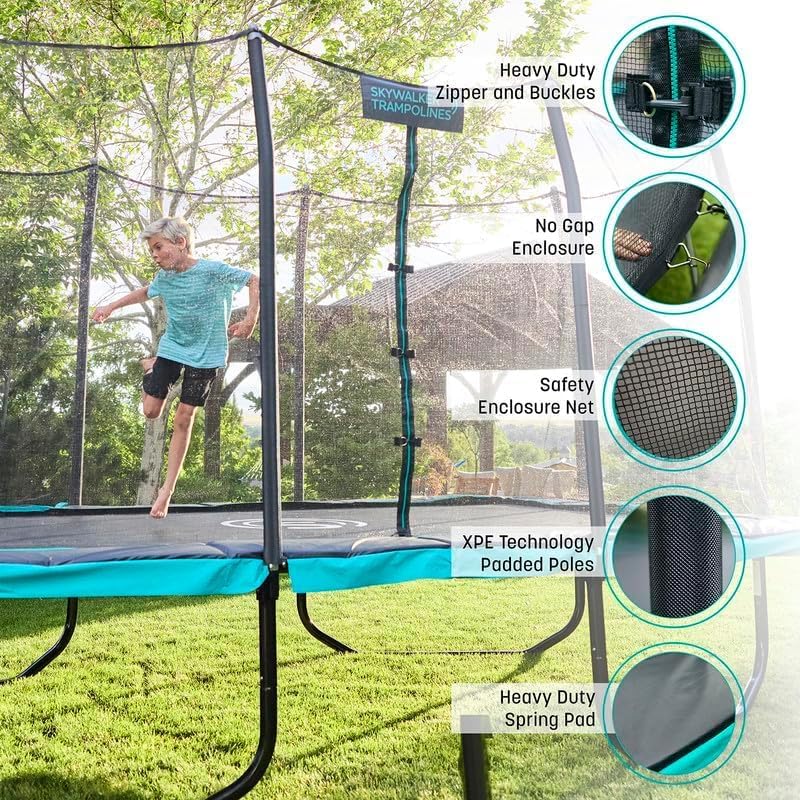
Size: 9 x 15 ft | Weight Limit: 250 lbs | Price Range: $$
Skywalker is one of the most trusted trampoline brands in the world, and their 9×15 rectangle model is a top pick for families who prioritize safety above all else. The patented no-gap enclosure system connects the net directly to the jumping mat, eliminating dangerous gaps where fingers and feet can get caught. The UV-resistant mat is built for years of outdoor use, and the easy-entry design makes it simple for kids to get on and off.
If you already own a Skywalker and need replacement parts, check out our Skywalker trampoline parts guide. And for more on how Skywalker’s weight ratings work, see our Skywalker weight limit guide.
- Best For: Families with young kids, safety-first buyers
- Pros: Excellent safety track record, trusted brand name, good price, easy assembly
- Cons: 250 lb weight limit limits adult use, not designed for advanced gymnastics
- Why Buy: Top pick for families who want peace of mind and reliable quality
6. Large Rectangle Trampoline with Enclosure (Walmart/SOFT INC.) — Best Budget Pick
Size: 10×17 ft or 9×15 ft | Weight Limit: 400 lbs | Price Range: $
If you’re looking for your first trampoline and don’t want to spend a fortune, the large rectangle models available through Walmart and SOFT INC. are a solid entry point. These trampolines come with an enclosure net and offer decent recreational bounce at a fraction of the cost of premium brands. They’re great for young kids and casual backyard use.
- Best For: Entry-level buyers, families on a tight budget, first-time trampoline owners
- Pros: Very affordable, solid bounce for recreational use, available in two popular sizes
- Cons: Not built for high-performance tricks or heavy adult use, shorter lifespan, 90-day warranty
- Why Buy: Perfect for testing whether your family will use a trampoline regularly before investing in a premium model
7. Beast K9 10×17 Performance Rectangle Trampoline — Best for Power Jumpers
Size: 10 x 17 ft | Weight Limit: 750 lbs | Price Range: $$$$
The Beast K9 is designed for serious jumpers—athletic teens and adults who want maximum height and responsiveness. The heavy-duty frame and responsive spring system deliver a powerful, controlled bounce that feels closer to a gym-grade trampoline. With a 750 lb weight capacity and 10×17-foot surface, it’s built to handle intense use year after year.
- Best For: Experienced jumpers, athletic teens and adults, high-performance training
- Pros: Built for durability and power, serious bounce quality, large jumping surface
- Cons: Expensive, limited user reviews compared to established brands
- Why Buy: If you want a trampoline that performs like a professional gym model in your backyard
Rectangle Trampoline Comparison Table (2026)
Use this table to quickly compare the key specs of every rectangle trampoline we reviewed:
| Model | Size | Weight Limit | Best For | Safety Features | Accessories | Price Range | Warranty |
|---|---|---|---|---|---|---|---|
| Acon Air 16 Sport HD | 10×16 ft | 1,100 lbs | Pros, Families | Premium enclosure, padded poles | Ladder, net | $$$$ | 10 yrs+ |
| Acon Air 13 Sport HD | 8×13 ft | 800 lbs | Smaller Yards | Premium enclosure, padded poles | Ladder, net | $$$ | 10 yrs+ |
| Upper Bounce Mega 10×17 | 10×17 ft | 500 lbs | Gymnasts | Full enclosure, padded frame | Ladder, net | $$$ | 1 yr |
| JumpKing 10×15 + Hoop | 10×15 ft | 250 lbs | Budget, Kids | Full enclosure | Basketball hoop, ladder | $$ | 1 yr |
| Skywalker Rectangle 9×15 | 9×15 ft | 250 lbs | Families, Safety | Patented no-gap enclosure | Ladder, net | $$ | 3 yrs |
| Large Rectangle (Walmart/SOFT) | 10×17 ft | 400 lbs | Entry Level | Basic enclosure | Net, ladder (opt) | $ | 90 days |
| Beast K9 10×17 | 10×17 ft | 750 lbs | Power Jumpers | Heavy-duty net, padded poles | Ladder, net | $$$$ | 2 yrs |
Click Here For Our Favorite Trampoline
Rectangle vs. Round Trampolines: Which Is Right for You?
This is one of the most common questions we hear. Here’s a quick summary to help you decide:
Choose a rectangle trampoline if: you want the highest-quality bounce, you’re training for gymnastics or cheerleading, you have multiple jumpers in the family, or your yard is long and narrow. Rectangle trampolines also give you more usable surface area edge to edge.
Choose a round trampoline if: you’re on a tighter budget, your primary users are young kids, or you prefer a trampoline that naturally directs jumpers toward the center (which some parents find safer for beginners).
For a detailed side-by-side comparison, including springless options, read our spring vs. springfree trampoline guide. And if you’re specifically interested in Springfree’s square and oval models (which share some benefits of rectangular trampolines), our Springfree buying guide covers those in depth.
How to Set Up and Maintain Your Rectangle Trampoline
Once your trampoline arrives, proper setup and ongoing care will keep your family safe and extend the trampoline’s life by years.
Setup Tips:
- Always install on flat, level ground—grass is ideal. Never place a trampoline on concrete or asphalt.
- Use an anchor kit (included with many models or available separately) to prevent wind movement.
- Have at least 2 adults for assembly. Budget 3–6 hours depending on the model.
- Considering an in-ground installation for a cleaner look and lower fall height? See our step-by-step in-ground trampoline installation guide.
Ongoing Maintenance:
- Inspect springs, mat, frame, and net before each season (and periodically during heavy use).
- Clean the mat with mild soap and water—avoid harsh chemicals.
- Replace any torn nets, worn spring pads, or stretched springs immediately.
- Use a trampoline cover during winter or severe weather.
- For a complete maintenance schedule and tips, see our trampoline maintenance & care guide.
Frequently Asked Questions About Rectangle Trampolines
Are rectangle trampolines safer than round ones?
They’re equally safe when installed properly and used with an enclosure. Rectangle trampolines have a more even bounce, which some families find reduces the chance of uncontrolled landings near the edges. The key to safety is always proper setup, regular inspection, and supervision. For a deep dive into trampoline safety, including what pediatricians recommend, read our comprehensive safety guide.
Are rectangle trampolines harder to assemble?
Yes—they typically take longer than round trampolines due to the more complex frame geometry. Having two adults and carefully following the instructions (ideally with a video tutorial) makes a big difference. Budget 3–6 hours for most rectangle models.
How do you maintain a rectangle trampoline?
Check bolts and frame connections regularly, clean the mat, store the ladder and net components during storms, and cover or disassemble the trampoline in winter. Replace springs, mats, and nets at the first sign of wear. Our trampoline care guide walks you through everything step by step.
Can adults use rectangle trampolines?
Absolutely—most premium rectangle trampolines have high weight limits specifically designed for adult use. The Acon Air 16 supports up to 1,100 lbs, and the Beast K9 handles 750 lbs. Always verify the specific weight rating of your model before adults jump. For brand-specific weight data, check our Springfree weight limit guide or Skywalker weight limit guide.
Are rectangle trampolines good for small yards?
Smaller models like the Acon Air 13 (8×13 ft) can fit in many suburban backyards. Always measure your space first and allow at least 3 feet of clearance on all sides. A rectangular shape can actually work better than round in narrow or long yards.
What’s the average lifespan of a rectangle trampoline?
Premium models with galvanized steel frames (like the Acon Air series) can last 7–10 years or more with proper maintenance. Budget models may need replacement parts—or full replacement—within 2–3 years. Investing in a higher-quality trampoline almost always saves money in the long run.
What size rectangle trampoline is best for gymnastics?
For gymnastics training at home, a 10×17 ft model (like the Upper Bounce Mega or Beast K9) provides the most room for tumbling and aerial routines. If your yard can’t fit a 17-footer, a 10×16 or 10×15 model will still give you excellent training space.
Do I need a trampoline ladder?
For rectangle trampolines with standard-height frames, a ladder makes getting on and off much easier and safer—especially for kids. Most of the models in our list include a ladder, but you can also purchase one separately.
Buyer’s Checklist: How to Pick the Perfect Rectangle Trampoline
Use this step-by-step checklist before you buy:
- Measure your yard and pick a size that fits with at least 3 feet of extra space on all sides and 24 feet of overhead clearance.
- Decide on a weight limit and bounce style—are you buying for young kids, athletic teens, adults, or a mix?
- Compare warranty terms and customer support reviews. A 10-year frame warranty is ideal.
- Look for safety certifications (ASTM, TUV) and full enclosure nets with no-gap designs.
- Consider accessories: ladder, basketball hoop, anchor kit, weather cover.
- Check assembly details—can you handle it with 2 people, or will you need extra help?
- Read our 2026 Backyard Trampoline Buyer’s Guide for additional research and tips.
Final Thoughts & Recommendations
Rectangle trampolines are the best choice for anyone who wants superior bounce, plenty of space, and a pro feel in their backyard. Here’s our quick summary:
Best Overall: The Acon Air 16 Sport HD is the ultimate pick for serious families and athletes—unmatched bounce, durability, and weight capacity.
Best for Smaller Yards: The Acon Air 13 Sport HD delivers the same premium quality in a more compact footprint.
Best for Gymnasts: The Upper Bounce Mega 10×17 gives you the most training space at a mid-range price.
Best Value: The Skywalker 9×15 and JumpKing 10×15 offer excellent quality and safety for most families without breaking the bank.
Best Budget Pick: Walmart/SOFT INC. large rectangle models are a great starter option for first-time trampoline buyers.
Always prioritize safety—set up your trampoline properly, use the enclosure, and keep an eye on kids at all times. For more expert advice on choosing, setting up, and maintaining your trampoline, explore our full library of guides at TrampolineGuide.net.
Click Here For Our Favorite Trampoline
25 Fun and Safe Trampoline Games for Kids of All Ages
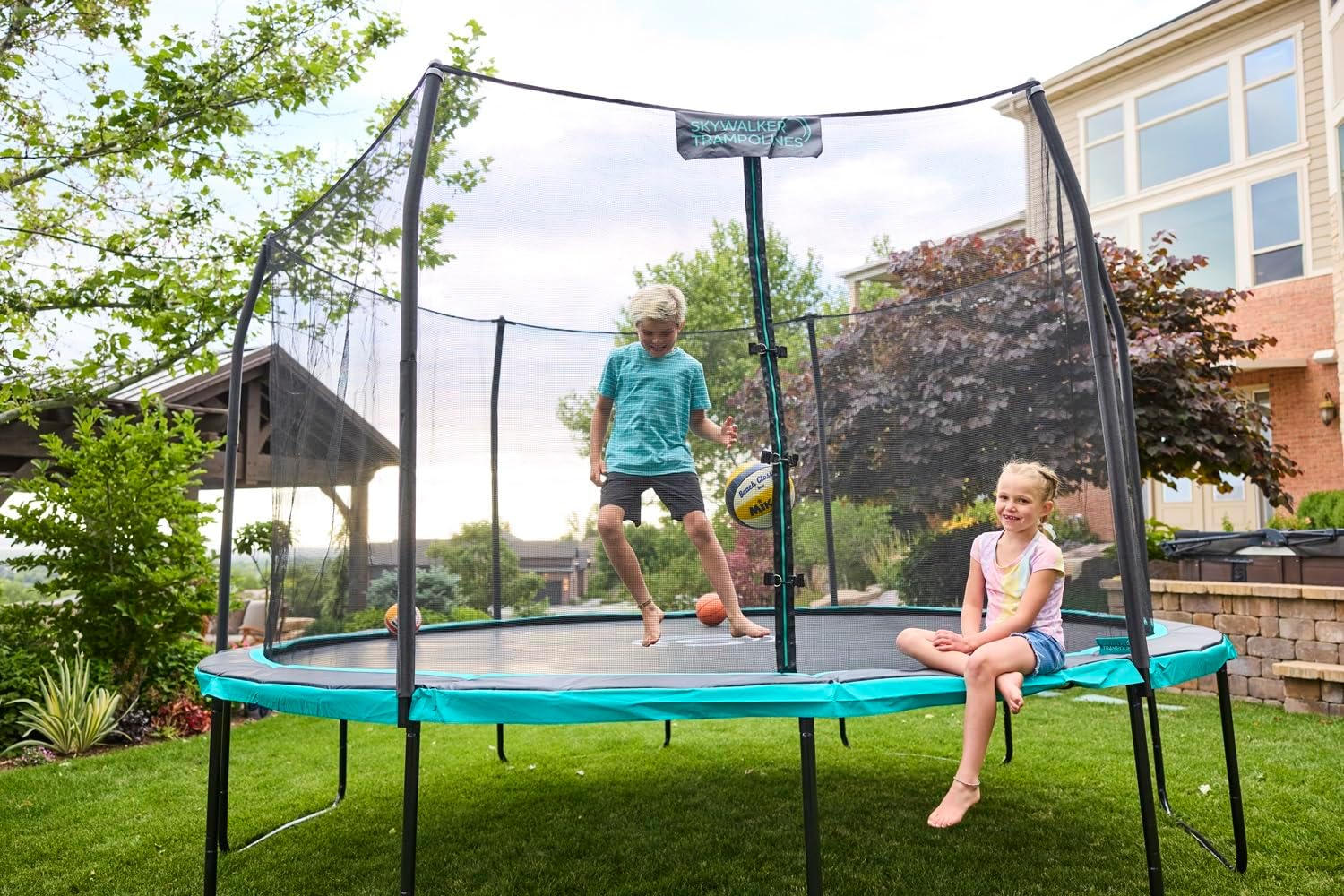
Trampolines aren’t just for bouncing up and down – they’re a launchpad for fun, creativity, and active play! Whether you’re looking for games to entertain kids at a birthday party or just want ideas for backyard fun, these 25 trampoline games are perfect.
From energetic challenges to creative activities, this list includes age recommendations and tips to help parents pick the right game for their kids.
Jump to a Game
1. Trampoline Dodgeball | 2. Crack the Egg | 3. Popcorn | 4. Trampoline Twister | 5. Follow the Leader | 6. Simon Says | 7. Horse | 8. Trampoline Tag | 9. Poison Ball | 10. Sprinkler Bounce | 11. Basketball Dunk Contest | 12. Pirate Treasure Hunt | 13. Dead Man | 14. Ball Bounce | 15. Freeze Bounce | 16. King/Queen of the Trampoline | 17. Musical Bounces | 18. Hot Potato | 19. Bounce to the Beat | 20. Trampoline Simon | 21. Don’t Fall Off the Island | 22. Ninja Warrior Course | 23. Handstand Challenge | 24. Obstacle Bounce | 25. Bubble Bounce
1. Trampoline Dodgeball
Ages: 6+
How to Play: Use soft foam balls or inflatable balls. Kids jump and dodge while trying not to get hit. The last player standing wins the round.
Parent Tip: Use lightweight balls to avoid injuries and limit the number of players on the trampoline at one time.
2. Crack the Egg
Ages: 5+
How to Play: One child sits in the center, hugging their knees to form the “egg.” Other players bounce gently around to make the “egg” crack — meaning the player in the center lets go of their knees.
Safety Note: Remind kids not to bounce too close to the person in the center.
3. Popcorn
Ages: 5+
How to Play: One player sits curled in a ball like a kernel of popcorn. Others bounce around them until they “pop” open. Take turns being the kernel.
4. Trampoline Twister
Ages: 6+
How to Play: Use chalk or colored tape to create colored circles on the trampoline surface. Call out body parts and colors — like “left hand on red” — to mimic the classic Twister game while bouncing.
5. Follow the Leader
Ages: 4+
How to Play: The leader performs a jump or simple trick, and the rest of the group must copy it exactly. Rotate leaders every few rounds.
Parent Tip: Great for younger kids who are learning basic moves and building confidence.
6. Simon Says: Trampoline Edition
Ages: 4+
How to Play: Play the classic Simon Says game with trampoline-themed commands like “do a seat drop” or “jump three times.” If a player follows a command that doesn’t start with “Simon says,” they’re out.
7. Horse (Trick Edition)
Ages: 7+
How to Play: Players take turns performing a jump or trick. If someone can’t copy it, they earn a letter. The first player to spell “HORSE” loses the game.
8. Trampoline Tag
Ages: 6+
How to Play: One player is “It” and tries to tag others while everyone jumps. Once tagged, the new player becomes “It.”
Safety Note: No pushing or rough play allowed. Light taps only.
9. Poison Ball
Ages: 6+
How to Play: Place a few soft balls on the trampoline. Players jump while avoiding contact with the “poison” balls. If you touch one, you’re out.
10. Sprinkler Bounce
Ages: 4+
How to Play: Place a sprinkler underneath the trampoline for cool, splashy summer fun. Kids jump through the mist for a refreshing twist on regular bouncing.
Parent Tip: Supervise closely to prevent slipping on the wet surface.
11. Basketball Dunk Contest
Ages: 6+
How to Play: Attach a trampoline-safe basketball hoop to the enclosure. Players take turns performing their best dunks with a small, soft ball. Vote on the most creative dunk.
12. Pirate Treasure Hunt
Ages: 3+
How to Play: Hide small toys or soft treasures on the trampoline. Players jump around and collect as many as they can. Whoever finds the most wins.
Parent Tip: Best for younger kids. Use soft, lightweight items only.
13. Dead Man
Ages: 6+
How to Play: One player sits blindfolded in the center and tries to find and tag others by crawling around. Other players jump and try to avoid being caught.
Safety Note: Use a soft blindfold and ensure all players move carefully.
14. Trampoline Ball Bounce
Ages: 5+
How to Play: Bounce a soft ball while jumping and try to keep it in the air as long as possible. Count how many bounces you can get in a row — it’s harder than it sounds!
15. Freeze Bounce
Ages: 4+
How to Play: Players jump until someone yells “Freeze!” Everyone must stop moving immediately. Anyone still bouncing or wobbling is out for the round.
16. King/Queen of the Trampoline
Ages: 6+
How to Play: One player stands in the center while others bounce around them trying to make them lose balance. The center player must stay standing to keep the crown.
17. Musical Bounces
Ages: 4+
How to Play: Play music while kids jump freely. When the music stops, everyone must freeze in place. Anyone who keeps moving is out. Think of it as musical chairs — without the chairs.
18. Hot Potato
Ages: 5+
How to Play: Pass a soft ball around while jumping. Play music in the background — whoever is holding the ball when the music stops is out for that round.
19. Bounce to the Beat
Ages: 6+
How to Play: Put on a favorite song and challenge kids to jump in time with the rhythm. Switch between fast and slow songs for variety. Great for building coordination.
20. Trampoline Simon
Ages: 6+
How to Play: A leader calls out increasingly complex jump sequences — like “two jumps, spin, seat drop” — and the rest of the group must copy them exactly. Miss a step and you’re out.
21. Don’t Fall Off the Island
Ages: 5+
How to Play: Place a blanket or towel in the center of the trampoline — that’s the “island.” Players must stay on the island while bouncing. Step off and you’re in the “ocean.”22. Ninja Warrior Course
Ages: 6+
How to Play: Add foam noodles, cones, or cushions as obstacles on the trampoline. Kids must jump over, around, or through them as fast as they can. Time each run for a competitive twist.
23. Handstand Challenge
Ages: 8+
How to Play: Players try to hold handstands or headstands on the trampoline while others gently bounce the surface. Last one to topple wins.
Safety Note: Supervise older kids closely. Only one person should attempt a handstand at a time.
24. Obstacle Bounce
Ages: 5+
How to Play: Use hula hoops, cones, or cushions as obstacles that kids must jump over or through. Create a course and let them race to complete it.
25. Bubble Bounce
Ages: 3+
How to Play: Blow bubbles from outside the trampoline while kids jump to pop them mid-air. Simple, magical, and endlessly entertaining for the youngest bouncers.
Tips for Parents
- Safety First: Always supervise children on the trampoline and enforce consistent trampoline safety rules. A safety enclosure net is a must.
- Age-Appropriate Games: Choose games that suit your kids’ ages and skill levels to prevent frustration or injuries. Younger children do best with simpler games like Bubble Bounce and Pirate Treasure Hunt.
- Add Props: Soft balls, foam noodles, hula hoops, and bubbles make games more fun and keep play safe.
- Mix Energy Levels: Alternate between high-energy games and calmer ones to keep kids entertained longer and reduce the risk of fatigue-related injuries.
Frequently Asked Questions
What are the best trampoline games for younger kids (ages 3–5)?
Great trampoline games for younger kids include Bubble Bounce (age 3+), Pirate Treasure Hunt (age 3+), Sprinkler Bounce (age 4+), Follow the Leader (age 4+), and Freeze Bounce (age 4+). These games are simple, easy to understand, and don’t require advanced jumping skills.
How can I make trampoline games safer for my kids?
Always supervise children on the trampoline, use lightweight foam balls instead of hard ones, limit the number of jumpers at one time, choose age-appropriate games, and make sure the trampoline has a safety net enclosure. Alternate between high-energy and calmer games to reduce fatigue-related injuries.
What trampoline games work well for birthday parties?
Trampoline Dodgeball, Musical Bounces, Hot Potato, Freeze Bounce, and Pirate Treasure Hunt are all excellent birthday party games. They’re easy to explain, accommodate multiple players, and keep kids entertained for extended periods.
How many kids should be on a trampoline at once?
Safety experts generally recommend one jumper at a time, but many of these games involve 2–4 kids. If playing with multiple children, choose a large trampoline with a safety enclosure, supervise closely, and make sure kids are aware of each other’s position to avoid collisions.
Conclusion
These 25 trampoline games provide endless entertainment, promote physical activity, and spark creativity for kids of all ages. Whether it’s a sunny afternoon or a birthday party, these games are guaranteed to keep everyone laughing and moving.
Try these games today and let the trampoline fun begin!
The Ultimate Backyard Trampoline Parts Checklist
Maintaining a backyard trampoline is a balance of performance and safety. Whether you are dealing with a stretched spring or a sun-damaged mat, using the right components ensures your equipment lasts for years of heavy use. If you have a Skywalker trampoline, we have a dedicated page here.
1. The Bounce System
The jumping mat and springs are the heart of the assembly. UV rays can weaken mat fibers, and metal fatigue can cause springs to lose their recoil over time.
- Mats: Look for 8-row stitching and UV-resistant polypropylene for durability.
- Springs: Use galvanized steel to prevent rust in humid climates.
2. Safety Netting & Padding
If your safety net is frayed or your frame pads have hardened, they can no longer absorb impact effectively. Replacing these is the easiest way to prevent “pinch” injuries from exposed springs.
Safety Net Guide
Top-Rated Pads
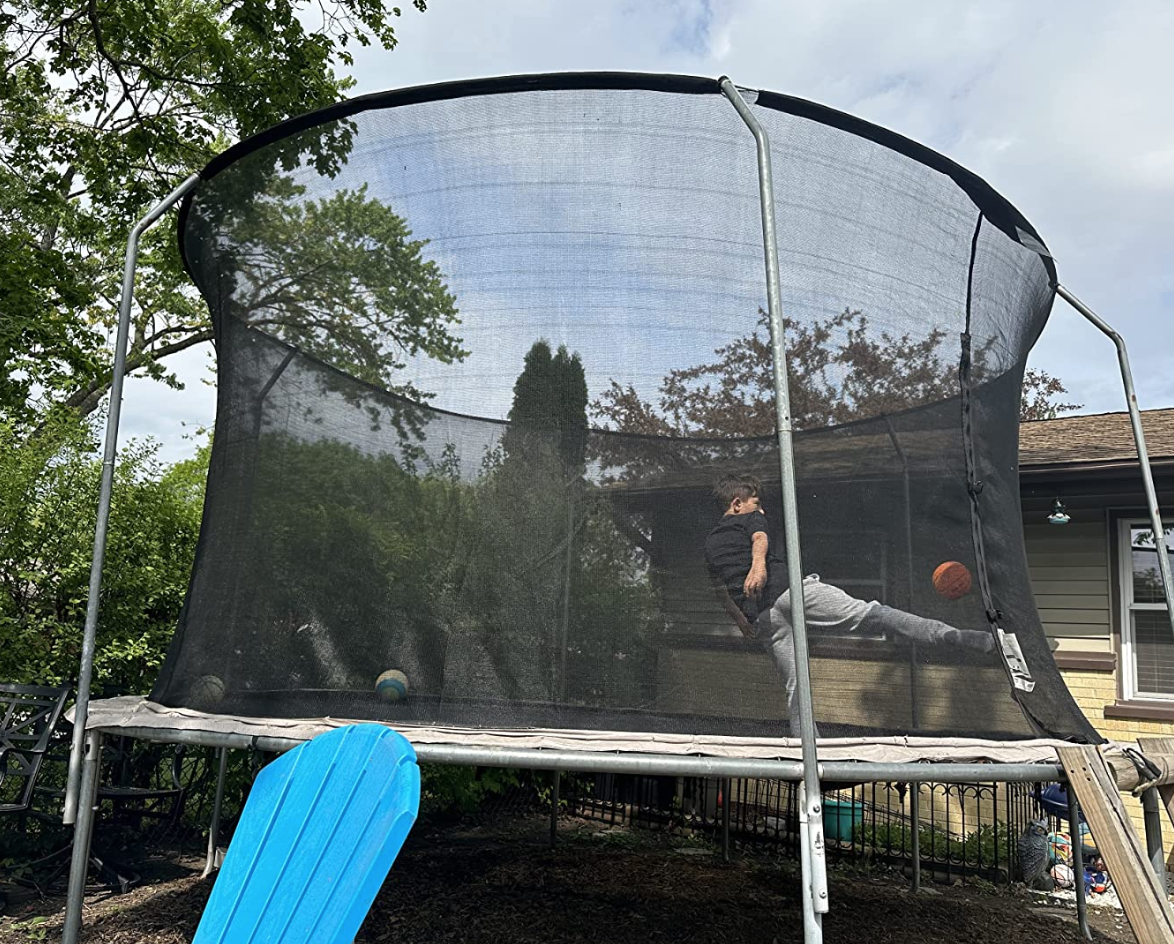
3. Structural & Access Parts
A safe trampoline needs to be easy to get on and hard to blow away. Ladders prevent kids from climbing the frame unsafely, while anchor kits keep the unit grounded during high winds.
Not sure which parts fit your brand? See our deep-dives into Skywalker replacement parts or our Ultimate Buying Guide.
Recommended Replacement Parts
Based on quality and durability, these are our top picks for standard 12ft trampolines.
Upper Bounce Jumping Mat
8-row stitching and UV-resistant fabric for maximum longevity.
Galvanized Springs
Heavy-duty 40-pack that includes a free T-hook installation tool.
The 2026 Backyard Trampoline Buyer’s Guide
The humble backyard trampoline has undergone a silent revolution. Once a simple recreational toy, it has transformed into a sophisticated piece of athletic equipment, engineered with precision to deliver both exhilarating performance and uncompromising safety. This isn’t just about buying a bounce; it’s about investing in kinetic energy management, advanced material science, and structural integrity that can withstand years of energetic play and challenging weather.
Navigating the market requires more than just picking a size. It demands an understanding of what truly makes a trampoline safe, durable, and fun. This guide will walk you through the essential considerations, including how to prepare your backyard for a trampoline, helping you decipher the engineering jargon and identify the perfect model for your home.
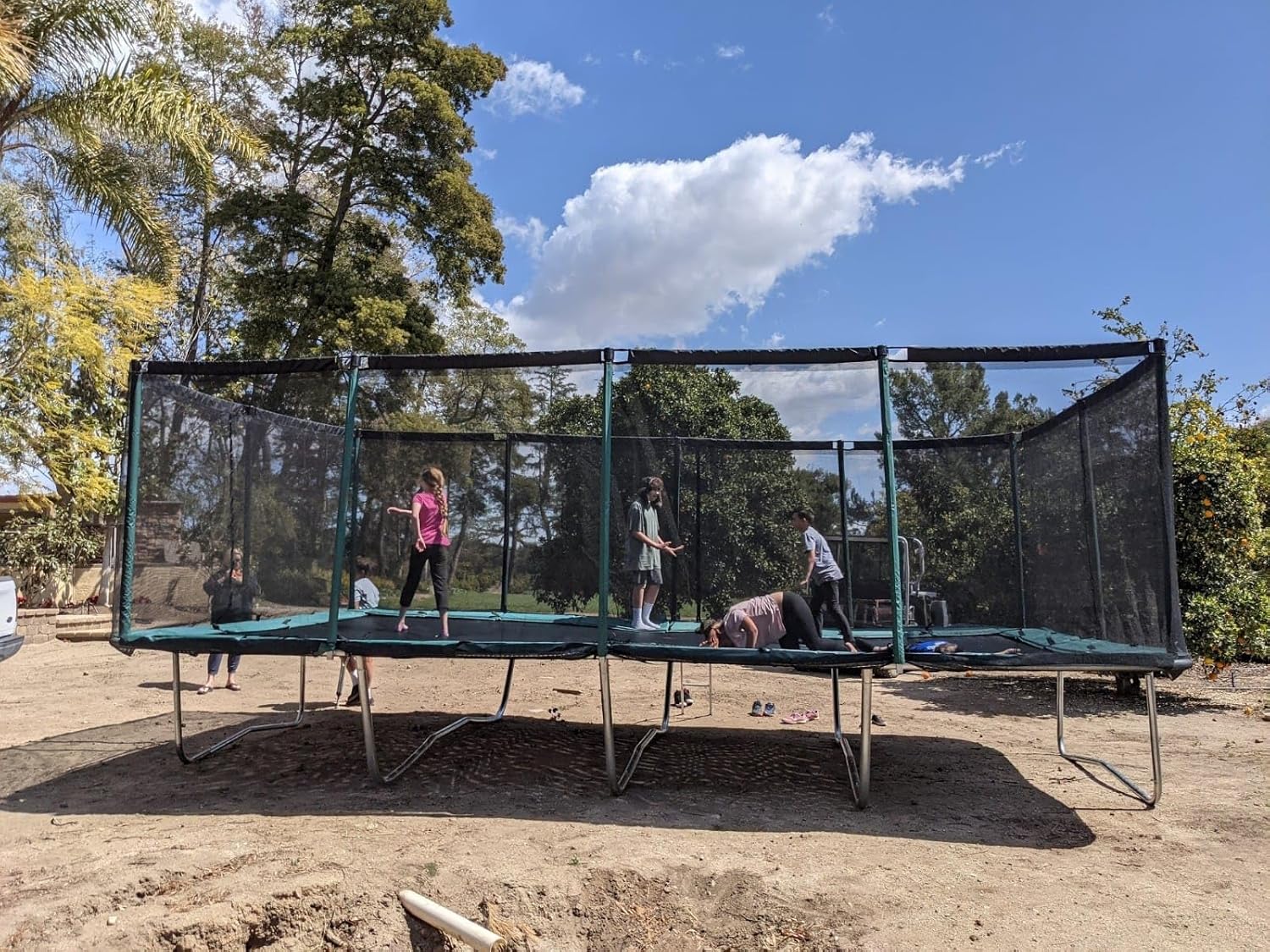
Finding Your Perfect Jumper Persona
Before diving into specs, ask yourself: Who will be jumping, and for what purpose? Your answer will immediately narrow down the field.
The Safety-First Family
You prioritize peace of mind above all else. Your focus is on eliminating pinch points, hard surfaces, and fall risks, especially for younger children. You’re willing to invest in cutting-edge designs that rewrite the rules of trampoline safety.
The Aspiring Athlete or Gymnast
You’re looking for serious airtime, consistent rebound, and space for tumbling or advanced tricks. Rectangular shapes, long springs, and high-performance mats are non-negotiable for achieving gymnastic prowess or aerial stunts.
The High-Capacity Household
With multiple energetic jumpers, teenagers, or even adults planning to join the fun, you need a trampoline built like a fortress. High weight limits, “zero-sway” frames, and expansive jumping surfaces are key to handling collective enthusiasm.
The Budget-Conscious Recreationalist
You want a reliable, fun, and safe trampoline without breaking the bank. You’re looking for the best value that meets essential safety certifications and offers a decent bounce for general backyard play.
Decoding the Core Technology: The “Big Three” Systems
The heart of any trampoline is its rebound system. Here’s how the leading technologies stack up:
| Rebound System | Core Mechanism | Characteristic Bounce | Ideal Application |
| High-Tensile Coils | Linear tension (Hooke’s Law) of piano-wire steel | High energy, responsive, athletic, powerful | Athletics, Gymnastics, advanced recreational |
| Composite Mat Rods | Cantilevered bending of fiberglass polymers | Soft landing, consistent, gentle deceleration | Safety-first families, low-impact exercise |
| Leaf Springs | Flexural compression of pre-curved steel plates | Even, stable, powerful, vertical, isolated from frame | Premium backyard use, unique safety architecture |
High-Tensile Coils: Still the benchmark for athletes, especially when made from high-tensile piano wire. Models like the ACON Air 16 HD utilize these for maximum energy return and responsiveness, allowing for incredible height and control.
Composite Mat Rods: Pioneered by Springfree, these revolutionary rods replace traditional springs entirely. They bend and flex beneath the mat, creating a “soft edge” and eliminating impact zones that cause most injuries. The result is a non-linear, softer bounce that’s incredibly forgiving on joints.
Leaf Springs: Found in systems like the Vuly Thunder Pro, these pre-curved steel plates offer a powerful, vertical bounce while completely isolating the rebound mechanism from the jumper. It’s a clever hybrid approach that prioritizes both performance and safety.
The Engineering Checklist: What to Look for Under the Hood
Beyond the springs, the underlying construction determines a trampoline’s lifespan and true safety.
The Foundation: Frame Physics
A flimsy frame dissipates energy, leading to a poorer bounce and faster metal fatigue. High-end manufacturers like Galactic Xtreme use heavy-duty galvanized steel frames with wall thicknesses up to 3.0 mm (9-gauge). This mass and rigidity are crucial for stability, especially during high-velocity maneuvers. For comparison, many budget models use thinner 1.5 mm steel.
Battling the Elements: The Rust Factor
Outdoor trampolines are constantly exposed to sun, rain, and temperature shifts. The best frames use hot-dip galvanization, a process that coats both the interior and exterior of the steel tubes with protective zinc, preventing rust from forming where you can’t see it. This is superior to standard spray galvanization, which often leaves the interior vulnerable.
Soft Part Longevity: Mats and Nets
The jumping mat (typically Permatron® polypropylene) and safety netting (often Raschel-knit polyethylene or polyester) are the primary failure points in cheaper models. Look for multi-layer UV treatments and materials that have undergone “wet-testing” or “salt-spray testing.” Brands like Springfree and ACON specifically engineer their soft parts for extreme environmental resilience, drastically extending their lifespan.
Safety Features That Truly Matter
Modern trampolines are designed with sophisticated safety architectures that go far beyond simple padding.
Passive Safety Systems
These features work automatically, without user intervention:
-
Curved Enclosure Poles: Angled away from the net, they create a buffer zone, preventing jumpers from colliding with hard supports.
-
Zipperless Doors: Overlapping entryways (like JumpSport AlleyOOP’s “UnForgettable” door) eliminate the common failure point of zippers, ensuring the enclosure is always secured.
-
Hidden Frames: Springfree’s design places the frame entirely beneath the jumping surface, making impact with hard metal impossible.
Active Safety Systems
These features require correct assembly to be effective:
-
No-Gap Enclosures: Found in models like Skywalker, this system threads the net directly through the mat’s V-rings, eliminating dangerous gaps between the mat and springs. Ensure it’s correctly installed to reap its benefits.
Enclosure Impact Strength
Don’t underestimate the net. High-end nets from brands like JumpSport and Springfree are rated to withstand an impact of nearly 300 lbs, capable of safely catching a fully grown adult falling at speed.
Deep Dives: Top 2026 Model Recommendations
Here’s a closer look at some of the industry’s leaders, categorized by their standout features:
The All-Around Safety King: Springfree Jumbo Square
Widely regarded as the safest trampoline ever engineered, the Springfree Jumbo Square completely removes springs and places its flexible composite rods beneath the jumping surface. This creates a “SoftEdge” mat and eliminates all traditional impact zones. With 155 square feet of usable jumping space (due to its edge-to-edge safety) and a 10-year warranty on all components, it’s the ultimate choice for peace of mind.

The Performance Heavyweight: ACON Air 16 HD Performance
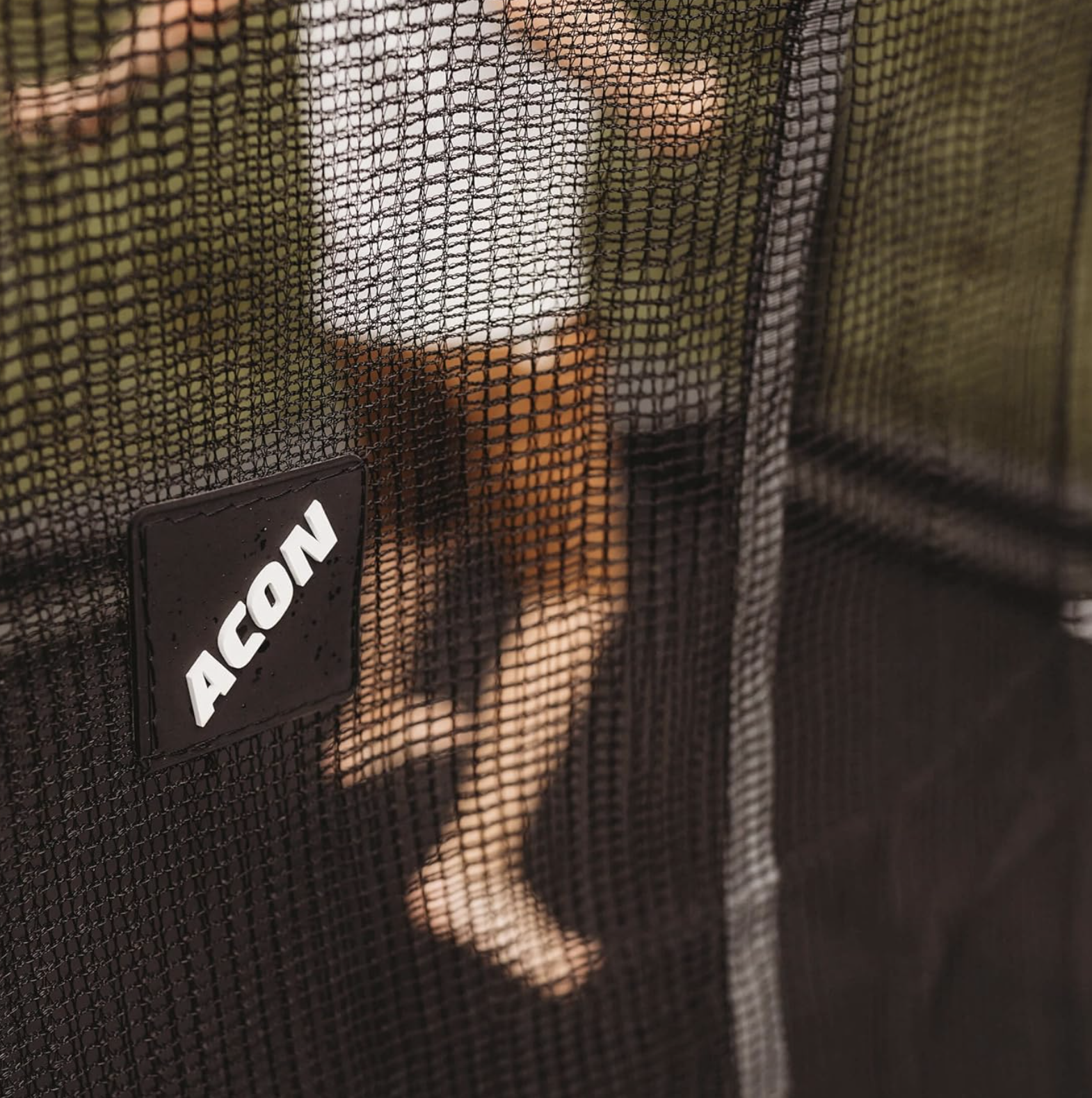
For serious gymnasts, tricksters, or those craving extreme bounce, the ACON Air 16 HD is engineered for maximum energy return. Its “Synergy Design” and 140 ten-inch springs, combined with “FlowTech” mat technology, provide a professional-grade rebound. With a massive 1,650 lb static load capacity and no single-user weight limit, it’s built to perform under intense use.
The Mid-Budget Value Champion: Jumpflex HERO 14ft
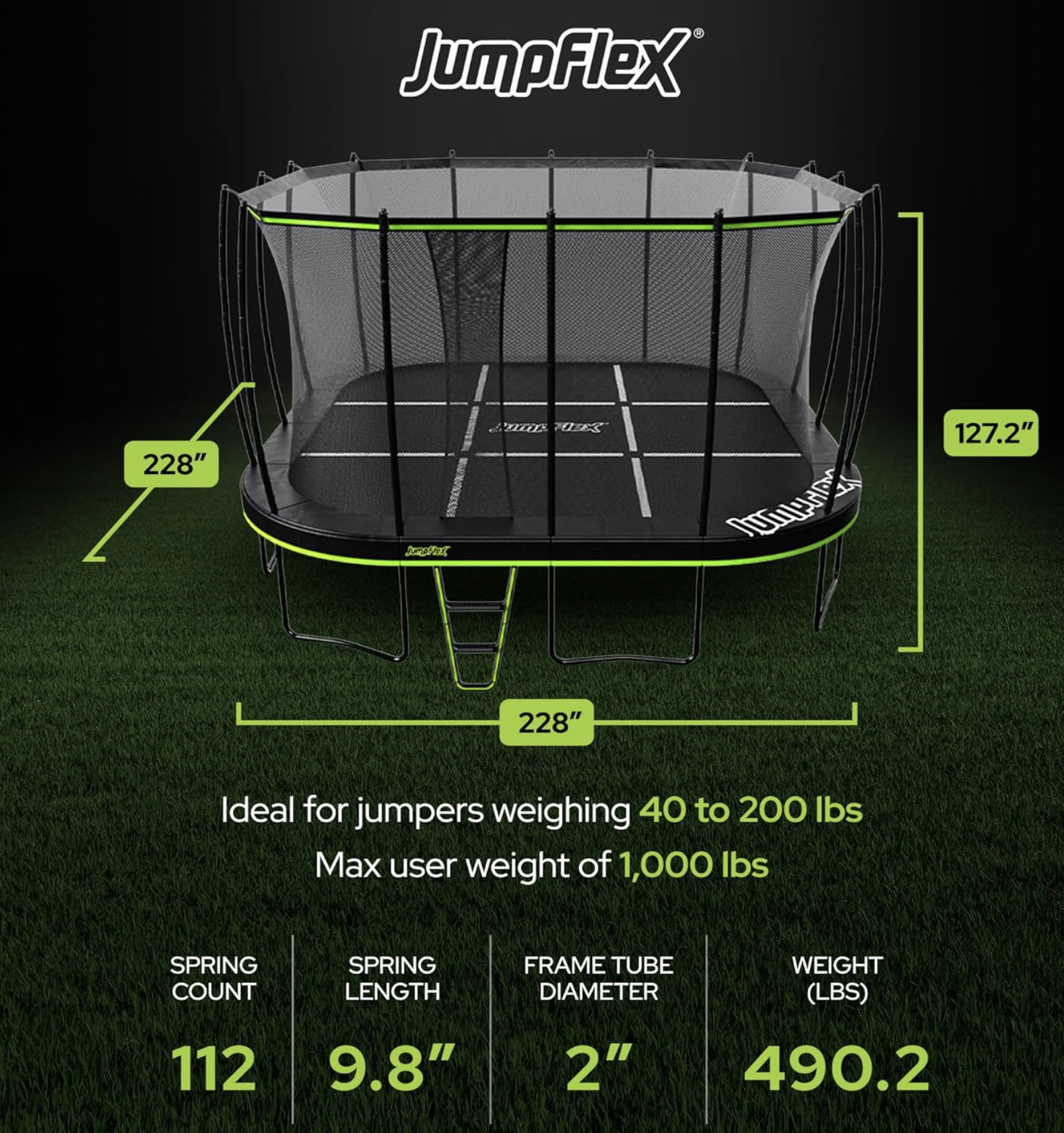
The Jumpflex HERO offers an excellent blend of safety, quality, and aesthetic appeal at an accessible price point. Its “bolt-free” assembly simplifies setup, and the 1.7-inch zinc-coated steel frame comes with a generous 10-year warranty. Curved, padded enclosure poles and an “Endless Weave” UV-tested net ensure long-term safety and durability, making it ideal for most suburban families.
Total Cost of Ownership: An Essential Perspective
While a budget trampoline might seem appealing upfront, consider the “Total Cost of Ownership.” A $300 model with a 1-year warranty that needs replacement parts (or the entire unit) every two years quickly becomes more expensive than a premium model costing three times as much but lasting a decade or more without significant part replacement. Brands like Springfree and ACON, with their extensive warranties and durable materials, offer superior long-term value, reducing maintenance headaches and ensuring continuous, safe fun for years to come.
Best Trampoline for Kids
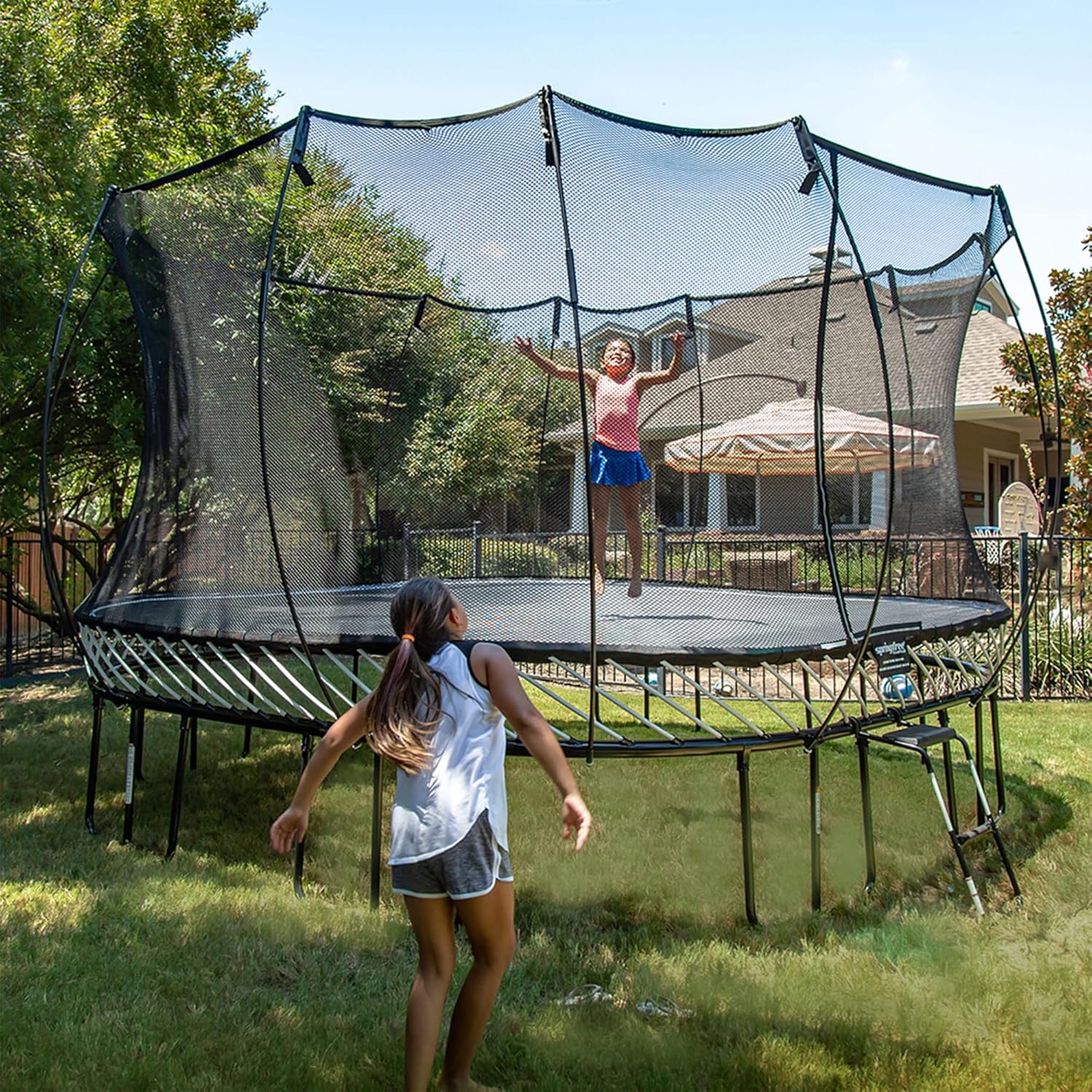
Click here for the overall top trampoline pick for kids
Choosing a trampoline for your kids can be exciting but also a big decision. With so many options out there, it’s important to focus on safety, quality, and durability to make sure you’re getting the best one. In this guide, we’ll walk you through some of the top trampolines for kids and share key factors to help you pick the right one for your family.
👉 Before you decide on a trampoline for your kits, grab our free Trampoline Buying Guide. It includes a detailed buying guide to help you choose the right trampoline and a safety checklist to keep your kids safe while they bounce. Get it here.
Best Trampoline for Kids
Springfree Square Backyard Trampoline with Enclosure

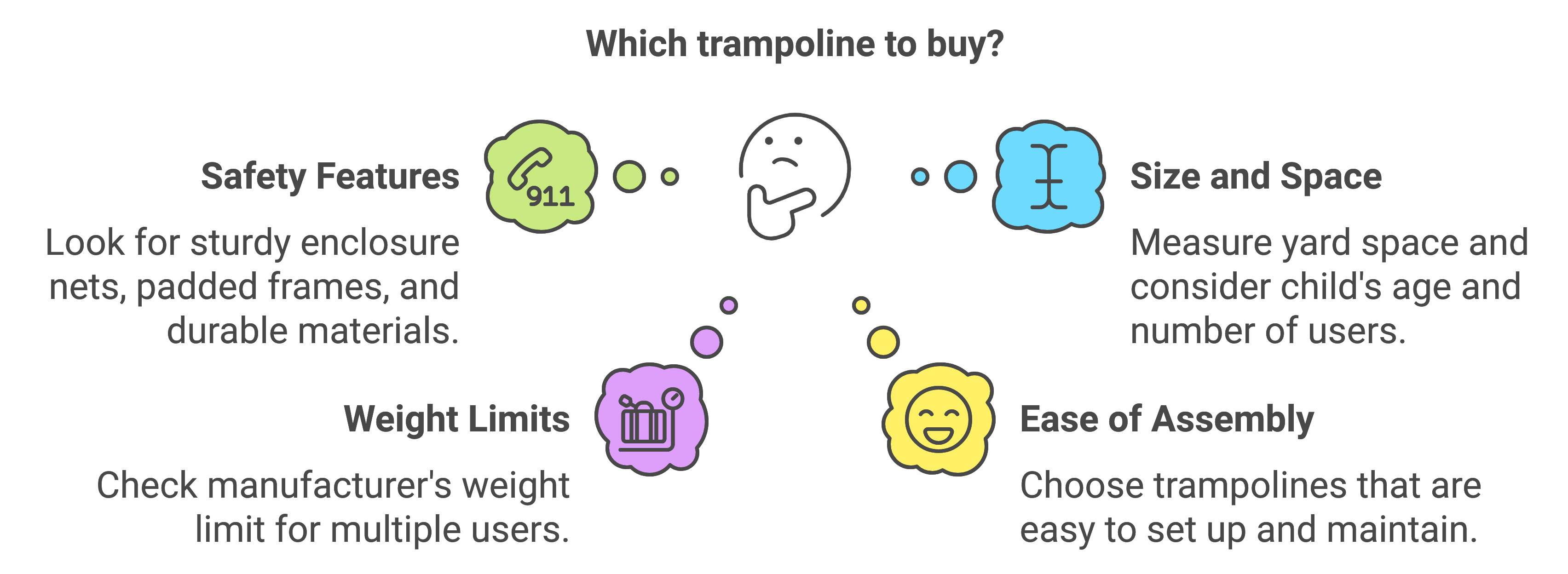
- Safety Features: Look for trampolines with sturdy enclosure nets, padded frames, and durable materials. Consider springless designs that eliminate common hazards like pinched fingers.
- Size and Space Requirements: Measure your yard and ensure there’s at least 2-5 feet of clearance around the trampoline. The right size depends on your child’s age, number of users, and available space.
- Weight Limits: Check the manufacturer’s weight limit to ensure the trampoline can handle multiple users safely.
- Ease of Assembly and Maintenance: Choose trampolines that are easy to set up and maintain. Regular inspections for wear and tear are necessary to keep the trampoline safe and functional.
Click here for the overall top trampoline pick for kids
Types of Trampolines for Kids
Click here for the overall top trampoline pick for kids
- Round Trampolines: Common for recreational use, they provide an evenly distributed bounce.
- Rectangular Trampolines: Preferred by gymnasts for a more powerful and controlled bounce.
- Square Trampolines: Combine the benefits of round and rectangular shapes, offering more jumping space with consistent bounce.
- Mini and Toddler Trampolines: Smaller models designed for indoor use, often with handles for added safety.
Best Trampolines for Kids
| Brand | Key Features | Shape Options | Weight Capacity | Click for Price |
|---|---|---|---|---|
| Springfree | Springless design, SoftEdge™ Mat | Round, Square, Oval | Up to 1,500 lbs | $$$$ |
| Skywalker | No-gap design, ASTM certified | Round, Rectangular, Oval | Up to 400 lbs | $$ |
| Acon Air | High flow bed, performance springs | Round, Rectangular | Multiple users | $$$ |
| Jumpflex | High-tensile steel frame, no-gap design | Round | Up to 550 lbs | $$$ |
| Jumpzylla | Rust-resistant, UV-resistant materials | Round | Varies | $$ |

Top Picks: Best Trampolines for Kids
Based on safety, quality, and user reviews, here are some of the best trampolines for kids:
Springfree Trampoline Jumbo Square
- Key Features: Springfree trampolines are designed with safety as the top priority. Instead of traditional springs, they use flexible composite rods beneath the jumping surface, which eliminates the risk of injuries. Other safety features include the SoftEdge™ Mat, a hidden frame, and the FlexiNet® enclosure.
- Shape Options: Available in round, square, and oval shapes.
- Weight Capacity: Up to 1,500 pounds.
- Why It’s Great for Kids: The innovative design minimizes risks, making it an excellent choice for families who prioritize safety.
Skywalker Trampolines – Jump-N-Dunk
- Key Features: Known for affordability and safety, Skywalker trampolines include tightly-woven enclosure nets, a no-gap design, and meet ASTM safety standards.
- Shape Options: Round, rectangular, and oval.
- Weight Capacity: Up to 400 pounds, depending on the model.
- Why It’s Great for Kids: A budget-friendly option without compromising safety. The no-gap design reduces the chance of accidents, making it ideal for younger children.
- Key Features: Durable with high-quality bounce, Acon Air trampolines feature a ‘high flow‘ bed that reduces air drag, enhancing performance. Users commend the brand for its long-lasting construction.
- Why It’s Great for Kids: Ideal for active children who enjoy high-energy bouncing, with strong materials that ensure the trampoline holds up over time.
- Key Features: Built with high-tensile steel frames, 360-degree safety nets, padded poles, and a no-gap design to ensure safety.
- Weight Capacity: Can hold up to 550 pounds.
- Why It’s Great for Kids: Combines a sturdy build with robust safety features, making it suitable for multiple users.
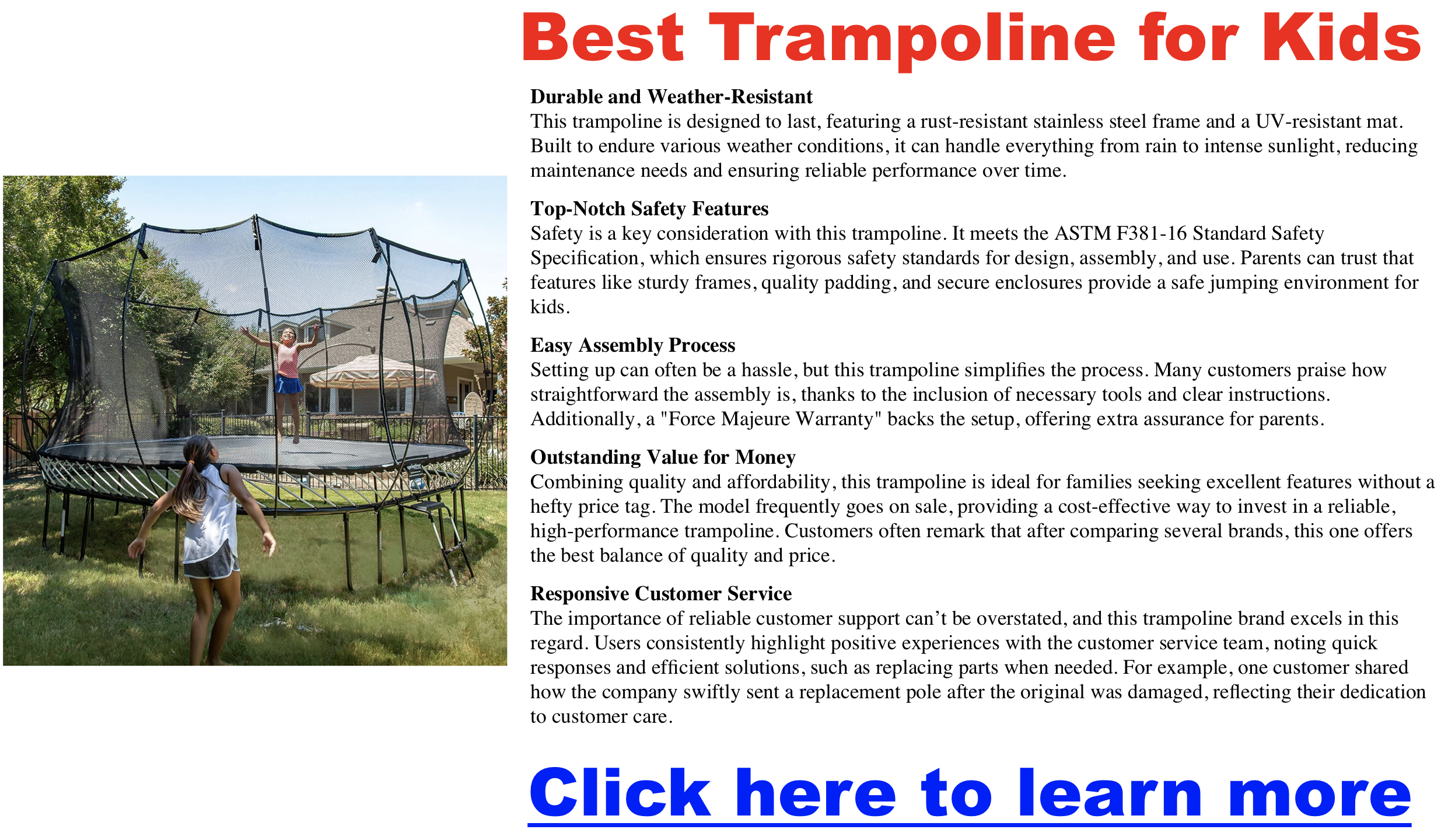
- Key Features: Designed with rust-resistant steel frames and UV-resistant mats, Jumpzylla trampolines adhere to ASTM F381-16 safety standards.
- Why It’s Great for Kids: Prioritizes safety and durability, making it a reliable pick for families looking for a trampoline that will last.
Safety When Choosing a Trampoline for Kids
Springless Trampolines
Springless trampolines, especially those produced by Springfree, are highlighted as one of the safest options available. Traditional trampolines use metal springs that pose a significant injury risk, as children may get their fingers or toes caught. Springless models, like Springfree’s, eliminate this hazard by using flexible composite rods or elastic bands beneath the jumping surface. This design prevents exposure to dangerous parts and provides a smoother, more controlled bounce. More on trampoline safety features here.
Key Safety Features:
- SoftEdge™ Mat: This mat, exclusive to Springfree, is 30 times more shock-absorbent than standard trampoline pads, reducing the risk of injuries from falls.
- Hidden Frame: The frame is placed beneath the jumping surface, out of the way of jumpers, to eliminate the possibility of contact.
Inground Trampolines
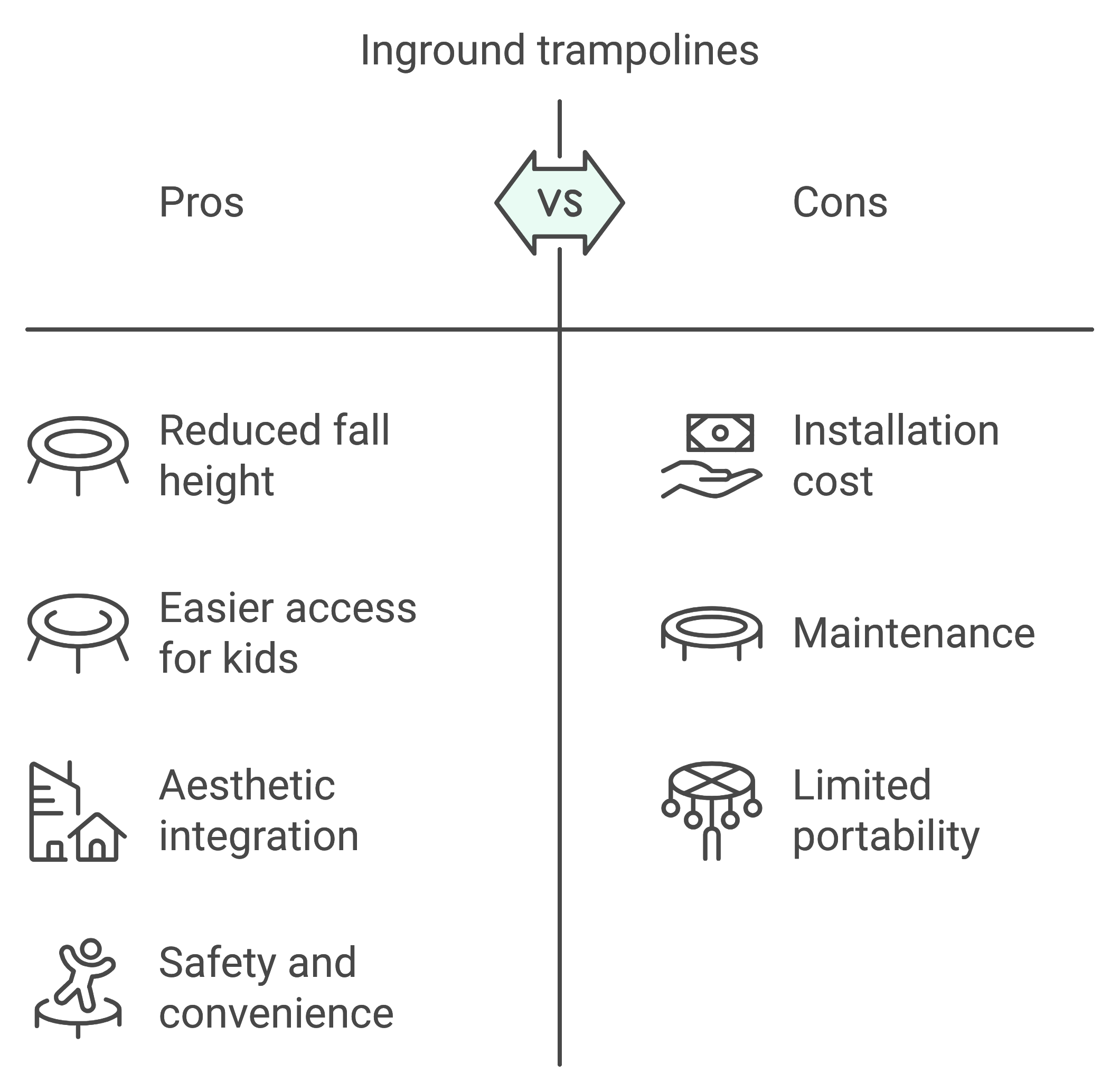
Inground trampolines are installed at ground level, reducing the fall height and minimizing the risk of serious injuries. These trampolines are easier for younger children to access and can be integrated aesthetically into outdoor spaces. They are a popular choice for families looking to blend safety with convenience.
Why They’re Safer:
- Reduced Fall Height: Being at ground level means there’s less distance to fall, lowering the risk of injury.
- Easier Access: Younger kids can easily get on and off without climbing, reducing the chance of accidental slips.
Traditional Trampolines with Enhanced Safety Features
Even traditional spring trampolines can be safe if they include the right safety enhancements. Here are some features to prioritize:
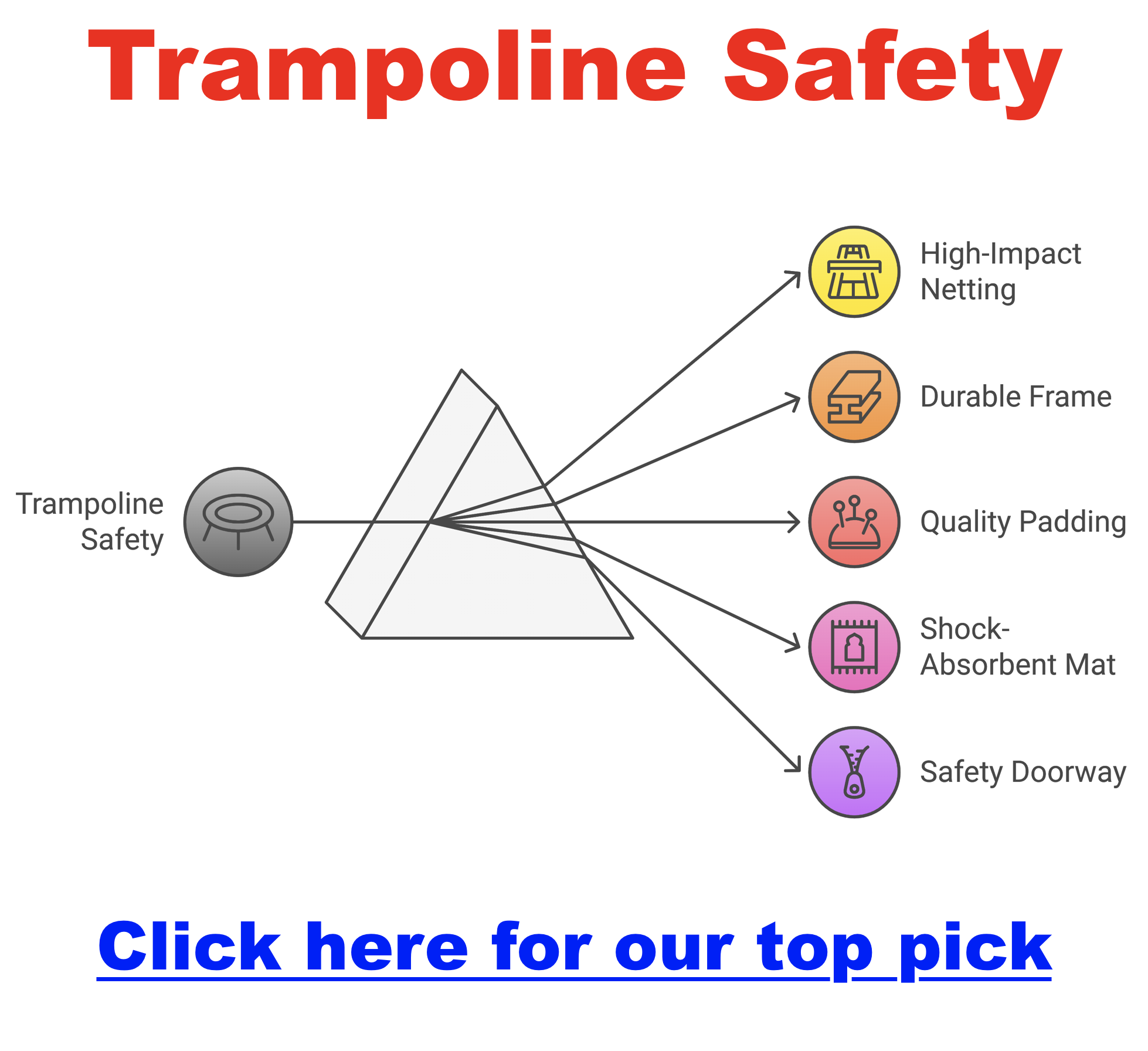
- High-Impact Enclosure Netting: Keeps jumpers within the safe jumping area and prevents falls.
- Durable Frame Construction: A sturdy frame, often made of galvanized steel, prevents tipping or collapsing.
- Quality Padding: Thick padding over springs and frame edges helps cushion any accidental contact, minimizing injury risks.
- Shock-Absorbent Mat: High-quality mats can absorb impacts effectively, providing a safer jumping experience.
- Safety Doorway Options: Enclosures should have secure entry points, such as zippers or overlapping designs, to prevent accidental openings.
Top-Rated Brands for Safety
Certain brands consistently stand out for their dedication to safety:
- Springfree: Known for their innovative springless design, Springfree trampolines are regarded as some of the safest on the market. Independent safety bodies have given them a 100% performance rating, and they’ve eliminated 90% of trampoline-related injuries.
- Skywalker: This brand focuses on affordability without compromising safety, featuring tightly-woven enclosure nets, no-gap designs, and rigorous ASTM safety testing.
- Jumpflex: Offers a sturdy build with comprehensive safety features, including a 360-degree safety net that extends to the bottom of the mat, padded poles, and UV-resistant netting.
- Acon Air: Renowned for durability and performance, Acon Air trampolines also integrate safety features like upgraded springs and a high-flow bed for controlled, safe bouncing.
- Jumpzylla: These trampolines prioritize safety and adhere to ASTM F381-16 standards, ensuring safe design, components, and assembly.
Additional Safety Considerations
To ensure a safe trampoline experience, consider the following practices:
- Proper Setup: Always install the trampoline on a flat, level surface with sufficient clearance above and around it. Soft ground beneath the trampoline can help absorb impact from falls.
- Maintenance: Regularly inspect the trampoline for wear or rust on the springs, frame, jumping mat, and net. Promptly repair any signs of damage.
- Supervision: Never leave children unattended on the trampoline. Establish rules, such as no flips or roughhousing, to reduce the risk of accidents.
- Weight Limits: Respect the manufacturer’s specified weight limits to prevent overloading, which can lead to damage or injuries. Skywalker weight limits. Springfree weight limits.
- Age Appropriateness: Most sources recommend a minimum age of 6 for using a full-size trampoline. Younger children should stick to mini trampolines designed specifically for their age and size.
Essential Safety Tips for Parents
- Supervision and Usage Rules: Always supervise children and set rules for safe play, such as one jumper at a time.
- Proper Use Recommendations: Encourage children to jump in the center and avoid dangerous stunts.
- Maintenance Checks: Regularly inspect for rust, loose springs, and tears in the mat. Replace any damaged parts promptly.
Frequently Asked Questions (FAQ)
What Shape of Trampoline Is Best for Kids?
- Round trampolines are ideal for younger kids due to their consistent bounce, while rectangular trampolines are better for older, more active children who may want to practice tricks.
How Much Space Do I Need for a Trampoline?
- Ensure there is at least 2-5 feet of clearance around the trampoline. Measure your available yard space and consider overhead clearance as well.
Are Springless Trampolines Safer Than Traditional Ones?
- Yes, springless trampolines eliminate the risks associated with exposed springs, such as pinched fingers or toes.
What’s the Right Size Trampoline for My Child’s Age?
- Smaller trampolines (6-8 feet) are better for younger children, while larger ones (12-15 feet) are suitable for older kids and multiple users.
How Do I Maintain My Trampoline to Ensure Longevity?
- Regularly check for wear and tear, clean the mat, and use a cover during harsh weather. If possible, store it indoors during winter to extend its lifespan.
Can Adults Use These Trampolines?
- Yes, as long as the weight limit is not exceeded. Many trampolines are designed to accommodate both kids and adults.
What Are the Benefits of Trampoline Exercise for Kids?
- Jumping on a trampoline improves cardiovascular health, balance, and coordination. It’s also a great way to boost mood and reduce stress.
Top 5 Rectangle Trampolines for Adults
When it comes to trampolines for adults, shape matters. Round trampolines dominate backyards, but if you’re serious about bounce quality, durability, or gymnastics-level performance, rectangular trampolines are the gold standard. They provide a higher, more consistent bounce, support heavier weight capacities, and offer more usable jumping space.
This guide breaks down the five best rectangular trampolines for adults — with sizes, weight limits, features, pros, cons, and price ranges — so you can find the perfect fit.
Why Rectangle Trampolines Are Best for Adults
- Even bounce across the mat – springs stretch independently, so you don’t get pushed into the center.
- Higher bounce potential – ideal for gymnastics, cheer, diving, or CrossFit training.
- Larger usable surface – corners add functional jumping area.
- Better for heavier users – frames and mats are built for higher capacities than most round trampolines.
Click Here For Our Favorite Trampoline
How We Chose the Top 5
We evaluated trampolines based on:
- Weight capacity – static and jumper limits suitable for adults.
- Durability – frame thickness, spring design, weather protection.
- Safety features – nets, padding, certifications.
- Warranty – strong manufacturer backing.
- Real-world use – feedback from athletes, fitness enthusiasts, and families.
🏆 Top 5 Rectangle Trampolines for Adults
1. Acon Air 16 Sport HD Rectangular Trampoline
- Size: 17 × 9.8 ft
- Weight Capacity: 1,650 lbs static, no single-user limit
- Features: 144 heavy-duty 8.3″ piano-wire springs, AirFlow mat (70% more airflow), tall safety enclosure
- Warranty: 10 years on frame, 5 years on springs/mat
Pros:
✔ Exceptional bounce — professional-grade feel
✔ Extremely durable frame and springs
✔ No single-user weight cap (rare in the industry)
Cons:
✘ Premium price (~$2,500–$3,000)
✘ Heavy and complex assembly
Best For: Serious adult users, fitness training, or families wanting a long-term trampoline.
2. Avyna Pro-Line Rectangle 10×17 ft
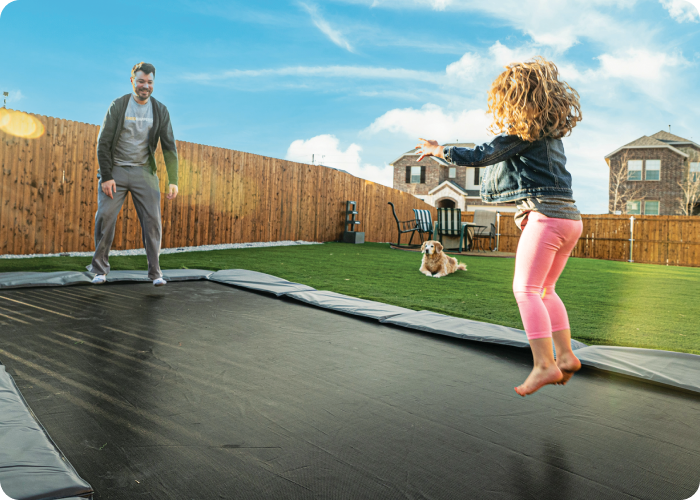
- Size: 10 × 17 ft
- Weight Capacity: 1,800 lbs tested
- Features: 128 large 8.5″ galvanized springs, Air X-TREAM mat, hot-dipped galvanized 11-gauge frame (rust-proof)
- Warranty: Lifetime frame, 3–5 years springs/mat
Pros:
✔ Extremely durable, built for decades
✔ Huge tested capacity
✔ Can be installed above ground or inground
Cons:
✘ Very expensive ($3,700+)
✘ Best for large yards
Best For: Buyers prioritizing long-term durability and professional-level performance.
3. Skywalker 17′ × 10′ Rectangle Olympic-Sized Trampoline
- Size: 17 × 10 ft (overall height ~10.8 ft)
- Weight Capacity: Up to 625 lbs (ASTM-tested, 4× load verified)
- Features: Oversized galvanized steel frame, springs over 50% larger than traditional Skywalker models, patented no-gap enclosure that interlocks net and mat to eliminate pinch points, reinforced T-sockets for extra stability
- Warranty: 10 years on frame & springs, 2 years on other parts
Pros:
✔ High weight capacity (625 lbs) — excellent for adults and families
✔ Even, consistent bounce across the mat
✔ ASTM-certified safety with no-gap enclosure system
✔ More affordable than ultra-premium models (~$1,600)
Cons:
✘ Warranty on non-structural parts is shorter (2 years)
✘ Not as heavy-duty or long-lasting as ACON, Avyna, or BERG
✘ Large, heavy, and requires significant yard space
Best For: Adults and families wanting a high-capacity, mid-priced rectangle trampoline with strong safety features and reliable bounce, without stepping into the ultra-premium price tier.
4. Upper Bounce Mega 10′ x 17′ Gymnastics Rectangle Trampoline
- Size: 10 × 17 ft
- Weight Capacity: 500 lbs
- Features: 108 galvanized springs, fiber-top enclosure net, 36″ frame height
- Warranty: 1 year on frame/springs
Pros:
✔ Affordable (~$1,300–$1,600)
✔ Comes with safety net
✔ Large jumping surface
Cons:
✘ Lower weight capacity than premium models
✘ Shorter warranty
Best For: Families or adults wanting a budget-friendly rectangle trampoline without sacrificing size.
5. Galactic Xtreme 13×23 ft
- Size: 13 × 23 ft
- Weight Capacity: 550 lbs
- Features: 172 heavy-duty 9″ springs, 3.0 mm steel frame, safety net included
- Warranty: Lifetime on frame and springs
Pros:
✔ Massive jumping surface (one of the largest residential trampolines available)
✔ Very robust with lifetime frame/spring warranty
✔ Great for group or gym-style use
Cons:
✘ Oversized — requires a huge yard
✘ Expensive (~$2,999)
Best For: Adults who want a supersized trampoline or gyms looking for heavy-duty equipment.
📊 Comparison Table: At a Glance
| Model | Size | Weight Capacity | Price Range | Best For |
|---|---|---|---|---|
| ACON Air 16 Sport HD PRO | 17×10 ft | 1,650 lbs (no single-user cap) | $2,500–$3,000 | Best Overall |
| Avyna Pro-Line 10×17 | 10×17 ft | 1,800 lbs | $3,700+ | Longevity |
| Skywalker 17′ | 11×17 ft | 350 lbs | $1,500+ | Gymnastics |
| Upper Bounce 10×17 | 10×17 ft | 500 lbs | $1,300–$1,600 | Budget |
| Galactic Xtreme 13×23 | 13×23 ft | 550 lbs | ~$2,999 | Oversized |
FAQ: Rectangle Trampolines for Adults
Why are rectangle trampolines more expensive?
They use thicker steel frames, longer springs, and pro-grade mats for higher performance.
Can multiple adults jump at the same time?
Even with high static limits, it’s safest to allow one jumper at a time.
Which has the highest weight capacity?
The Avyna Pro-Line (1,800 lbs tested) and ACON Air 16 (1,650 lbs, no jumper cap).
Do they last longer than round trampolines?
Yes — premium rectangle trampolines often last 10+ years with proper care, especially with warranties up to lifetime on frames.
Expert Tips for Adult Use
- Choose the right size for your yard — many rectangles need more space than round models.
- Stick to the published jumper weight limits even if the structural capacity is higher.
- Use a safety enclosure, especially for higher bounce trampolines.
- Clear off snow, water, or debris to prevent frame stress.
- Register your warranty immediately after purchase.
Conclusion
For adults, rectangle trampolines deliver superior bounce, durability, and support compared to round models.
- 🥇 Best Overall: ACON Air 16 Sport HD PRO
- 🛡️ Most Durable: Avyna Pro-Line 10×17
- 🤸 Best for Gymnastics: Galactic Xtreme 13×23
- 💲 Best Budget Pick: Upper Bounce 10×17
- 🌍 Biggest Option: Galactic Xtreme 13×23
No matter your choice, a rectangle trampoline gives you professional-level performance and safety — making it the best long-term investment for adults.
Springfree Trampoline Warranty: What You Need to Know
When you’re investing in a premium trampoline, the warranty matters almost as much as the weight limits and safety features. Springfree sets itself apart with one of the most comprehensive warranties in the industry.
Full Coverage for 10 Years
Every new Springfree trampoline purchased since September 2017 has a 10-year warranty on all components. That means the frame, mat, rods, net, and padding are covered — bumper to bumper — for a full decade. Most competitors only cover parts of the trampoline for 1–5 years.
Accessories & Spare Parts
-
Accessories (like ladders, sunshades, and anchors): 1-year warranty
-
FlexrBall: 3 months
-
Spare parts purchased separately: 2-year warranty
Transferable Warranty
Another standout: Springfree’s warranty is transferable. If you buy or sell a used Springfree trampoline, the remaining coverage carries over with proof of purchase — rare in the trampoline market.
What’s Not Covered
Like most warranties, it excludes:
-
Misuse, improper setup, or commercial use
-
Weather damage (snow, wind, storms)
-
Normal wear and tear
The Bottom Line
Springfree’s 10-year all-parts warranty makes it one of the most reliable family trampolines you can buy. If long-term durability and peace of mind are high on your list, Springfree’s warranty coverage is a major reason to choose them over budget brands.